The third quarter of 2026 was the period tokenization moved into regulated production. The Depository Trust & Clearing Corporation, which settles nearly every US securities trade, ran live tokenized trades of blue-chip stocks and Treasuries. A global asset manager brought a tokenized money market fund to retail-facing venues in Asia. Regulators in the US, Europe, and across Asia each advanced their frameworks within the same twelve weeks. Underneath the announcements, the on-chain value kept climbing, while the distance between assets that are tokenized and assets that actually trade stayed wide.
This report covers where the market stands, what changed in Q3, and what is worth watching into Q4.
What The Market Has Learned Since 2018
The tokenization market did not begin with the term "RWA." When InvestaX built its first token issuance platform in 2018, on top of a broker-dealer licence, the sector was still called security token offerings, and the tooling was largely limited to issuance itself. Regulated custody was scarce, secondary trading barely existed, and there was no established buy-side. Deals were often tokenized first and marketed second, on the assumption that putting an asset on-chain would attract demand on its own.
That assumption did not hold, and the market spent the following years correcting it. Regulated trading venues and custodians emerged. And in 2022, InvestaX secured one of the first Recognised Market Operator licences in Singapore for a security token exchange using public protocols.
The turning point on demand came from an unexpected direction: when DeFi yields fell sharply in 2022 and 2023, crypto and stablecoin holders went looking for stable returns, and tokenized US Treasury bills gave them one. That is when the current market took shape and it carried a lesson the market still runs on. The assets that found demand were the ones that made sense as investments on their own terms, with tokenization improving how they were distributed, settled, and used rather than substituting for quality.
The market has also moved into a further phase. Having spent years getting assets on-chain, the industry is now building the layer that determines what institutions can actually do with a tokenized asset once they hold it, as collateral, in lending, and in settlement, rather than leaving it idle in a wallet. Several 2026 developments illustrate the shift:
- BlackRock's BUIDL fund became usable as yield-bearing collateral for trading, through a framework with OKX and Standard Chartered as regulated custodian, letting institutions earn Treasury yield on margin capital that would otherwise sit idle.
- DTCC, LSEG, Euroclear, and Tradeweb completed a cross-border intraday repo using tokenized UK gilts, while the Bank of England opened a lab to explore tokenized settlement with central bank money.
- Tokenized equities began functioning as on-chain collateral, letting eligible investors in permitted jurisdictions borrow stablecoins against tokenized shares while maintaining their economic exposure to the underlying assets.
Speaking on BitGo's "From The Vault" podcast, InvestaX co-founder and CEO, Julian Kwan, described the assets that have won so far as sharing four characteristics: US dollar-backed, institutional quality, yield-bearing, and offering daily redemption. Tokenized Treasuries fit that profile closely, which is why they led. The market has since started to build the next layer on top of that foundation, extending into higher-yielding assets that keep the same qualities, private credit chief among them, and making tokenized assets usable within on-chain infrastructure as collateral and in settlement rather than sitting idle.
A Snapshot Of The RWA Tokenization Ecosystem
The market's growth is reflected across the major trackers. RWA.xyz records roughly $38 billion in tokenized RWA value on public blockchains by late August 2026, up from around $20.6 billion a year earlier, with the holder base passing 2.5 million over the quarter. RWA.io places the total RWA market value higher, near $345 billion. While the exact numbers vary depending on how the data is counted, tens of billions of dollars in real assets are now living on the blockchain.
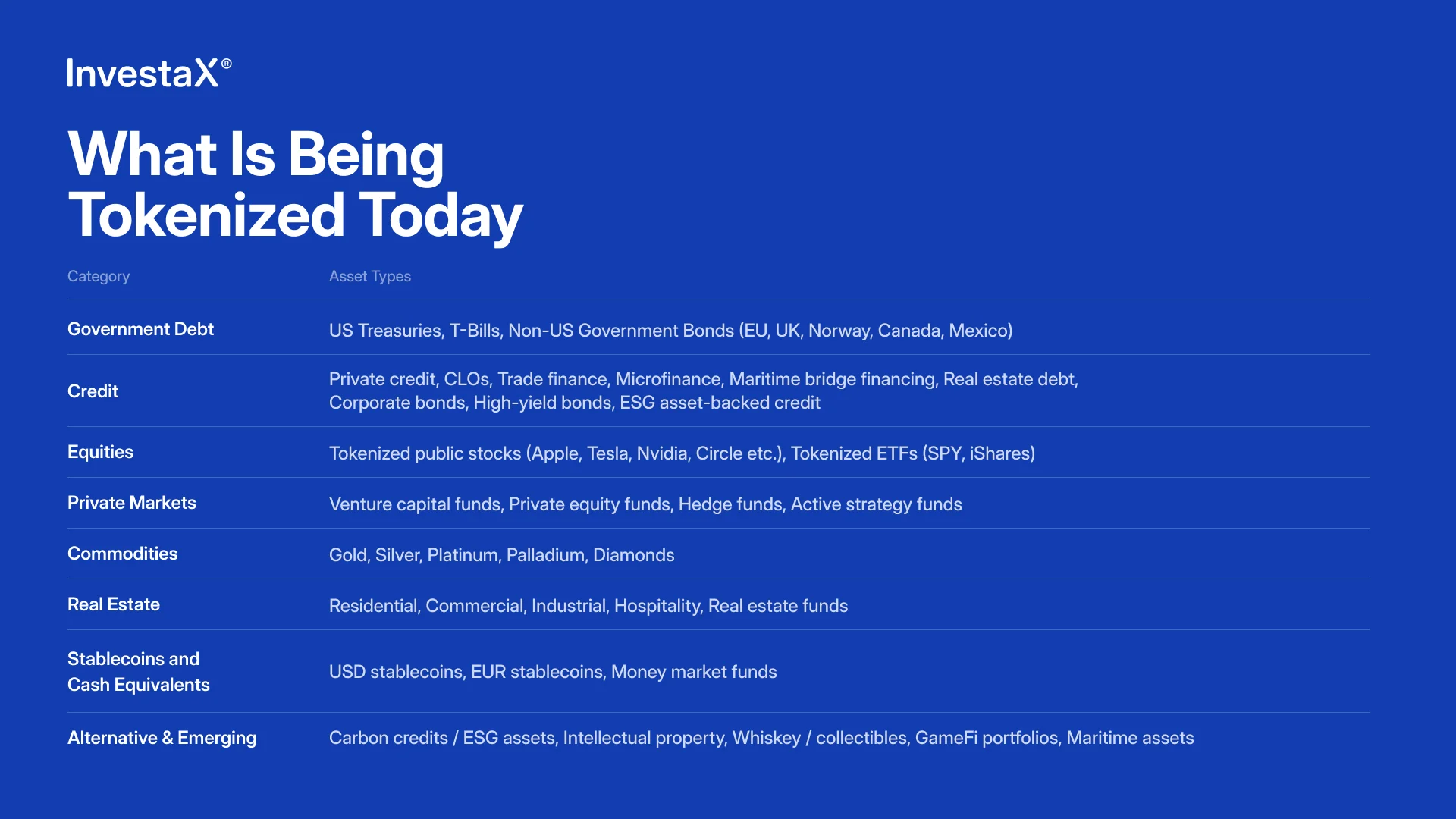
What is being tokenized has broadened well beyond the Treasuries that led the first wave. The market now spans:
- US Treasuries and money market funds, still the largest category
- Private credit, the fastest-growing non-Treasury segment
- Commodities, led by gold
- Corporate and non-US government bonds
- Tokenized equities and ETFs
- Real estate, maritime and trade financing, renewable-energy assets, intellectual property, and institutional alternative funds
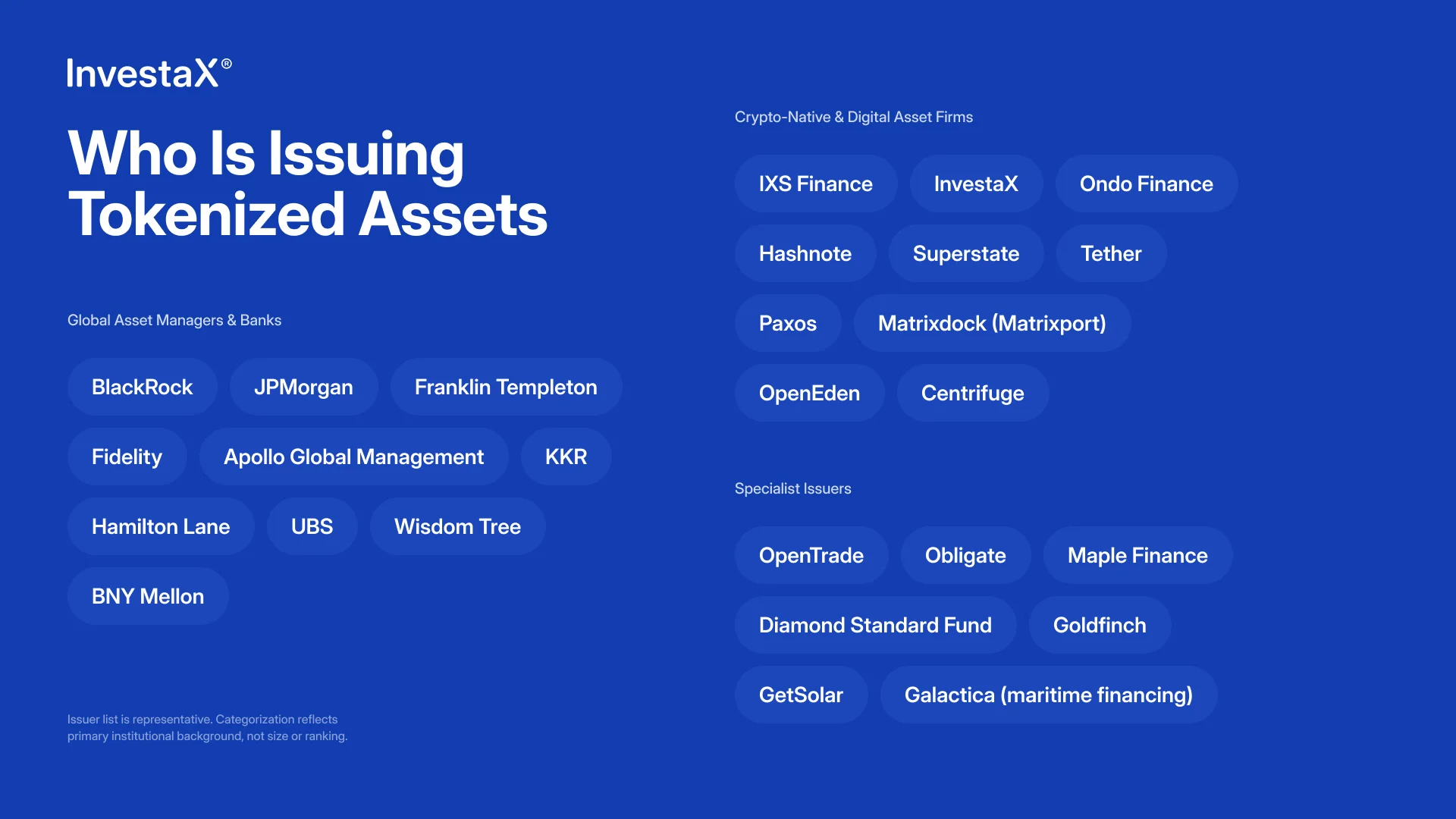
The issuer base has broadened just as much. Global asset managers and banks including BlackRock, Franklin Templeton, Fidelity, J.P. Morgan, and Apollo now sit alongside digital-asset firms such as InvestaX and IXS, and specialist issuers such as Galactica, GetSolar, Matrixdock, and Obligate. Many of these assets are accessible through InvestaX's regulated tokenization platform, which now spans money market funds, Treasuries, high-yield corporate bonds, private credit, and real-economy assets such as solar energy and maritime financing. For a fuller view of how the ecosystem fits together, our RWA tokenization ecosystem map breaks it down by layer and asset class.
Hundreds of billions of dollars in stablecoins hold no yield for the people who own them. That gap, idle stablecoin capital looking for a stable, dollar-denominated return, is the demand engine underneath tokenized Treasuries, money market funds, and increasingly the vault structures discussed later in this report.
The market in Q3 2026
The quarter brought a mix of developments across regions and asset types. Live settlement infrastructure going into production, regulators moving on their own timelines and in different directions, new products reaching investors in Asia, and continued demand for on-chain yield. The developments below cover the ones most relevant to institutions tracking the space.
Regulated production goes live
In Q3 2026, RWA tokenization in the U.S. continues to move into live, regulated infrastructure, with established financial institutions running real trades and regulators sketching the rules around them.
- On 15 July, DTCC announced that it has run its first live production trades of tokenized securities, Microsoft and Circle shares, the Invesco QQQ and SPDR S&P 500 ETFs, a short-term Treasury ETF, and US Treasuries, with close to 40 institutions participating. The tokens were structured as "digital twins" carrying the same ownership, dividend, and governance rights as the underlying securities. The trades settled under a three-year SEC no-action letter, with a full commercial launch scheduled for October.
- Private-market tokenization scaled alongside it. Securitize, a regulated tokenization platform and SEC-registered transfer agent, extended Hamilton Lane's tokenized private-credit fund (HLSCOPE) to more chains. Securitize also completed its business combination with Cantor Equity Partners II to begin trading on the NYSE on July 2 at a $1.25 billion valuation, becoming the first pure-play tokenization company to go public.
In addition, US regulatory posture shifted in parallel. On 18 August, the SEC proposed "Regulation Crypto Assets," the first tailored offering regime for certain crypto investment contracts and the centerpiece of Chairman Atkins' Project Crypto initiative. The proposal is at an early stage, with a 60-day comment period, and is worth monitoring as the regulatory picture develops. It builds on a consistent line from the SEC that tokenized securities remain securities, with Commissioner Hester Peirce having noted that moving an activity on-chain does not move it outside the securities laws.
Asia sets the distribution pace
If the US led on settlement infrastructure this quarter, Asia accelerated on getting tokenized products in front of investors.
- On 24 August, Franklin Templeton began distributing its tokenized US government money fund, grBENJI, to professional investors in Asia through HashKey Exchange's Earn channel, extending a product it first launched in Hong Kong in late 2025. This is paired with a US SEC no-action letter allowing certain of its registered funds to hold the on-chain fund for cash management.
- In an earlier move, Franklin Templeton launched its OnChain U.S. Dollar Short-Term Money Market Fund on InvestaX, expanding access to regulated, tokenized money market instruments for investors in Singapore and across Asia.
- GetSolar, one of Singapore's more prominent residential solar companies, launched GetSolar AssetCo Series 1, a tokenized senior secured loan backed by residential and commercial solar projects, issued through InvestaX's MAS-licensed tokenization platform.
Singapore continued to widen its institutional base. The Investment Management Association of Singapore and the UK's Investment Association became the first asset-management trade bodies to join Project Guardian, now spanning 40+ institutions. This sits against the Future of Finance Institute, the standing AI-and-tokenization body MAS announced on 25 June.
Hong Kong advanced on a parallel track, progressing the tokenization and stablecoin components of its LEAP framework, with Standard Chartered becoming the first bank to distribute the regulated Hong Kong dollar stablecoin HKDAP.
At the same time, India moved toward its first tokenized corporate bond, a sub-$60 million pilot by state-owned REC, using DLT for issuance and settlement and wholesale CBDC for purchase, with a secondary market targeted for late 2026.
Europe recalibrates
Europe spent the quarter tightening and revisiting its framework at the same time.
- MiCA reached full EU-wide enforcement on 1 July, ending its transitional phase.
- The MiCA 2.0 consultation closed on 31 August, addressing non-EU stablecoins, tokenized deposits, and custody resilience, areas the original text left thin.
- The ECB advanced its settlement infrastructure. Its Pontes programme, providing tokenized central bank money for EU distributed-ledger markets, is planned from September, and the ECB began accepting DLT-based assets as eligible Eurosystem collateral earlier in 2026. European issuers have now placed close to €4 billion in DLT-based fixed income since 2021.
MiCA reached the end of its transitional phase on 1 July, moving to full EU-wide enforcement. In parallel, MAS's European counterparts opened the MiCA 2.0 consultation, which closed on 31 August and addresses the treatment of non-EU stablecoins, tokenized deposits, and custody resilience, areas the original text left thin. The European Central Bank's Pontes programme, providing tokenized central bank money as a settlement anchor for EU distributed-ledger markets, is planned to begin from September.
The US, Europe, and Asia each advanced their frameworks over the quarter. For an institution operating across borders, that means keeping several regulatory regimes in view at once, since a product distributed across regions may fall under different rules in each.
The rise of the RWA vault
Across industry conversations this quarter, one structure came up more than any other: the vault. The interest follows directly from the stablecoin demand described earlier. A real-world asset (RWA) vault is an on-chain structure that holds a tokenized claim on an underlying real-world asset and issues a token representing a depositor's share. It gives a platform or an individual holder a way to route idle stablecoin balances directly into a regulated, yield-generating asset and redeem out of it, without building the underlying infrastructure themselves.
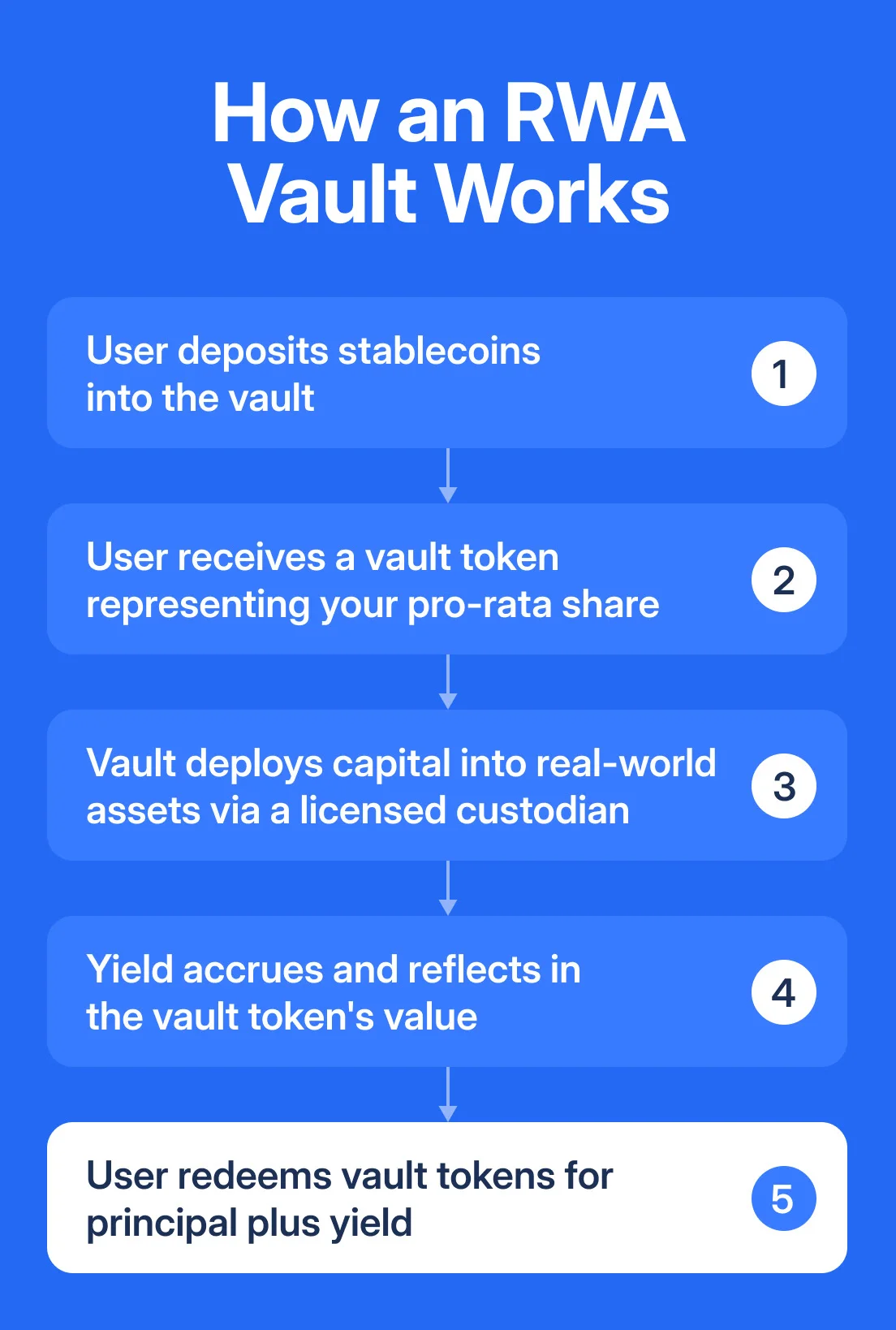
Our sister company IXS launched new RWA vaults this quarter under its Bahamas DARE Act licence, open to both human users and AI agents. Its flagship vault tracks BlackRock's iShares High Yield Corporate Bond ETF, giving depositors exposure to institutional-grade corporate bond returns on-chain with no lock-up period. Learn more at ixs.finance/vaults.
Tokenized assets continue to move from holding to utility
This quarter, RWA tokenization continues to move beyond issuance to building a usable portfolio on-chain. Tokenized Treasuries and money market funds are increasingly used as collateral and reserves rather than held passively.
BlackRock's BUIDL continued to serve as collateral across derivatives and DeFi lending platforms, letting institutions post a yield-bearing Treasury token as margin instead of idle stablecoins, and keep the yield while the collateral is in use.
The same pattern is appearing across the category, with tokenized Treasury products from managers including BlackRock and Franklin Templeton being integrated into exchange collateral and reserve workflows. An asset that earns yield and can also be posted as collateral is more capital-efficient than holding cash and the asset separately.
Still, the utility remains uneven. A BeInCrypto Research found that of tokenized RWAs worth more than $100,000, assets representing roughly 56% of measured value, about $32.9 billion, recorded no weekly on-chain transfers. The market is also concentrated: 62 assets account for about 88% of total value, and five products for roughly half.
The assets seeing real use are concentrated in the largest, most liquid Treasury products, while much of the rest of the market is still early in building that same depth. The utility layer is real and expanding, and for now it is furthest along where the underlying assets are most liquid and standardised, which is a reasonable place for it to start.
What to watch in Q4
Several threads from this quarter reach a decision point in the next.
- DTCC's commercial tokenization service is scheduled to launch in October, which will test whether the July pilot holds at production scale.
- The MiCA 2.0 consultation moves into its response phase, shaping how the EU treats non-EU stablecoins and tokenized deposits.
- Hong Kong's first tokenized money market fund settlement is expected in Q4.
- And private credit looks set to keep climbing the yield curve as institutions move from testing Treasuries toward higher-yielding assets, the segment most likely to define the market's next phase, and the one where credit quality and structuring discipline will matter most.
The through-line across all of it is the same one the market has been working toward since 2018. Tokenization is most valuable when it improves how a sound asset is distributed, settled, and used. The infrastructure that went live this quarter, from DTCC's settlement rails to regulated vaults and cross-border fund distribution, is what turns that idea into working plumbing.
---
This report is for informational and educational purposes only and does not constitute investment, legal, tax, or financial advice, or an offer or solicitation to buy any security or token. References to specific products, issuers, and offerings are provided for market context and are not recommendations. Figures are drawn from publicly available sources including RWA.xyz and issuer disclosures, believed accurate as of writing, and market data varies by methodology and source. Any yields or returns referenced are indicative, not guaranteed, and past performance is not necessarily indicative of future performance.