This article provides a structured overview of real-world asset (RWA) tokenization, explaining what it is, how it works, where the market is heading, and the regulatory considerations shaping its adoption. It also outlines the benefits and challenges involved, the types of assets most commonly issued today, and the licensing requirements that apply in different jurisdictions.
Key Takeaways:
- Real-world asset tokenization creates a regulated digital representation of traditional financial products, while the underlying legal and economic rights remain governed by existing frameworks.
- Adoption continues to grow across private credit, U.S. Treasuries, commodities, and institutional fund structures, supported by a steady increase in regulated pilots and industry participation.
- Tokenization may strengthen efficiency, transparency, and operational consistency by consolidating onboarding, registry maintenance, servicing, and reporting into a single environment.
- Risks and challenges remain, including regulatory fragmentation, technology and custody considerations, and varying secondary-market structures across jurisdictions.
- Licensing requirements depend on asset classification and local regulations. Activities involving tokenized securities typically fall within established capital-markets rules.
- The overall trajectory signals a gradual integration of tokenization into mainstream financial infrastructure as standards, market practices, and regulatory clarity continue to evolve.
What is Real-World Asset Tokenization?
Real-world asset tokenization is the process of creating a digital representation of an asset on a distributed ledger, typically a blockchain. The digital token reflects the legal rights attached to the underlying asset through an established structure, such as an SPV, trust, or fund vehicle.
Tokenization is not simply a technological overlay, but a transformation of how assets are issued, managed and transacted. Instead of relying on multiple systems for investor onboarding, registries, payments, and reporting, tokenization places these workflows on a shared infrastructure. This does not change the economic terms of the asset. It provides a different operational environment for managing it.
Tokenization also supports fractionalization. In a regulated format, a token can represent a defined portion of the underlying asset. This gives institutions a framework to structure ownership in smaller units, which can support more flexible distribution models while remaining within established regulatory boundaries.
A Brief History Of The RWA Tokenization Industry
Jenny Johnson, the CEO of Franklin Templeton, the $1.5T USD global investment firm, says “Bitcoin is the greatest distraction from the biggest opportunity in finance, tokenized assets”.
Real World Asset Tokenization is now experiencing explosive growth despite the fact it has actually been in development for the past five years and has been “rebranded” several times along the way.
Here is a brief timeline of some of the key events in the history of the RWA market (which is also called the Security Toke Offering (STO) market) and the digital securities or tokenized securities industry.
- 2017: One of the first STOs was launched by Blockchain Capital and raised $10M USD in a single day. It was a tokenized venture capital fund.
- 2018: The security token market, as it was called that year, grows rapidly with over $1 billion raised. Token issuance-only (technology) companies were the main infrastructure available for issuers wanting to “tokenize” their assets and launch an STO. OpenFinance also launched as the world’s first STO exchange.
- 2019: The security token market matures with more regulatory clarity and a growing number of security token platforms. tZero launches as one of the first regulated security token exchanges in the world. InvestaX built its first token issuance platform on top of its broker dealer license. The first security token custodians start to surface.
- 2020: The security token market continues to grow with over $2 billion raised. The industry is starting to see more infrastructure come to market, including broker-dealers and custodians for security tokens. JP Morgan builds its own token infrastructure platform called ONYX to tokenize public assets, so they can be lent or borrowed, which wasn’t possible in their previous format.
- 2021: The security token market sees a slowdown due to the COVID-19 pandemic but still raises over $1 billion and infrastructure players continue to grow. Crypto titans Binance, Bitfinex and FTX launch their first STO, albeit improperly, as they were unlicensed and were forced to remove those offerings. At the same time, DBS Bank in Singapore launched a crypto exchange. These moves signaled that the decentralized finance (DeFi) players are coming for the STO industry and the traditional finance (TradFi) players are coming for the crypto industry.
- 2021: IXS Finance launches the world’s first automated market maker (AMM) for security tokens, launching the first legal and compliant liquidity pools for security tokens. This is the killer application solving the liquidity issues in the STO market.
- 2022: STO market continues to grow with over $1.5 billion raised and more platforms going live. All major financial institutions have launched security token projects and/or are building their own internal capabilities. InvestaX secures one of the first Recognized Market Operators licenses in Singapore for a security token exchange, the first using public protocols.
- 2023: “Tokenization” momentum continues to grow because infrastructure is now ready for end-to-end issuance. The other major event that happened was due to the DeFi meltdown in 2022/2023, resulting in there being no yields available for crypto investors. So, we witnessed the first tokenized treasury bills paying high yields. This meant the holders of crypto, and specifically stable coins like USDC, started investing into tokenized T-bill and the DeFi industry created the acronym “RWA”. Now, we are seeing an explosion of new RWA tokens coming to market, including structured products, money market funds, tokenized derivatives, and more.
So, although traditional finance knows “RWA” to mean risk weighted asset, the on-chain finance now uses it to explain security tokens or asset backed tokens.
What Types Of Assets Are Most Commonly Tokenized Now?
A wide range of assets can be brought into a tokenized format. This includes financial instruments such as debt, equity, fund units, participation certificates, and structured products. Real assets such as real estate, gold, and art can also be represented through regulated structures.
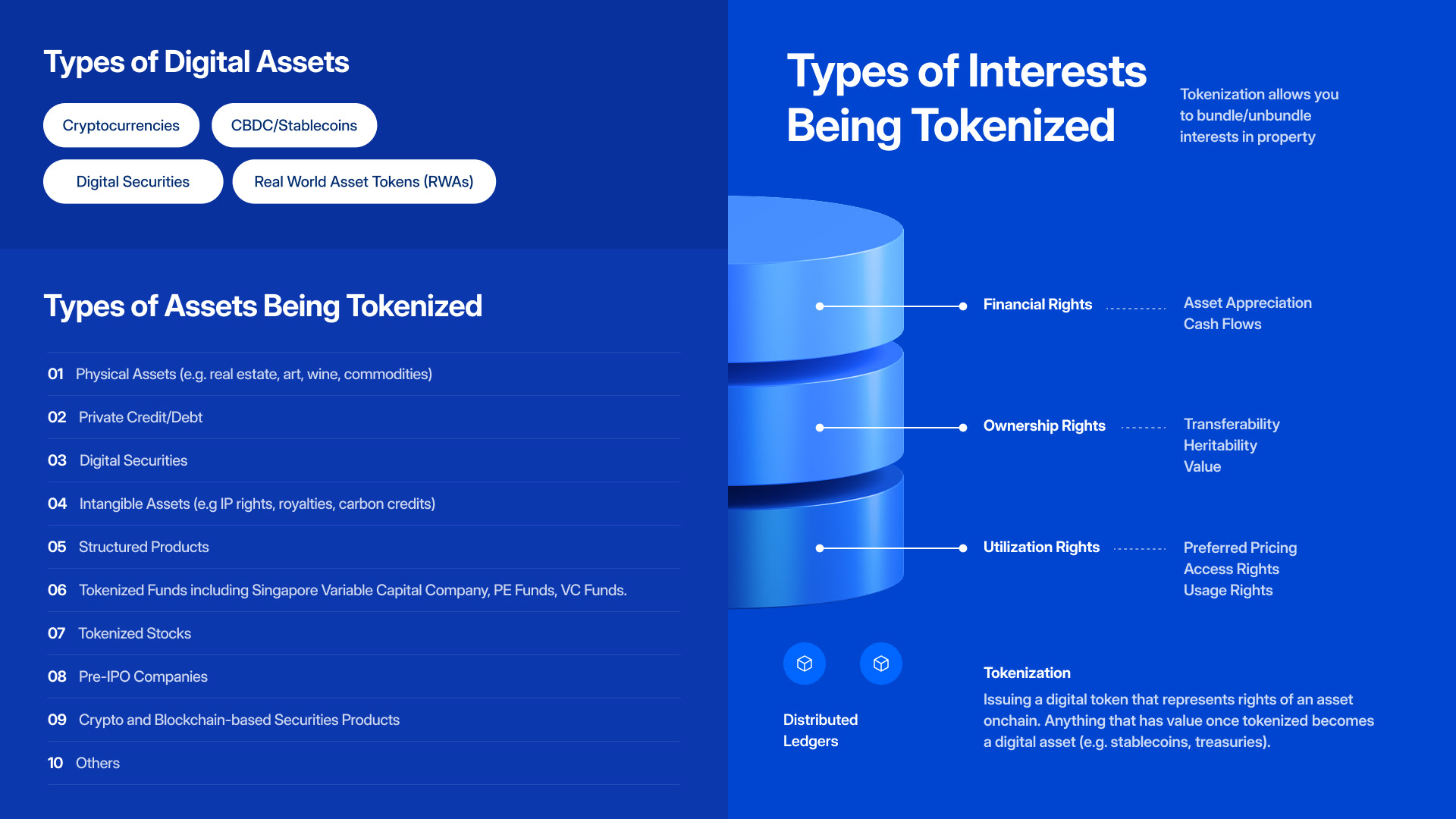
Current market data shows several categories with meaningful activity.
Private credit
Private credit remains the largest category in the tokenized RWA market. According to rwa.xyz (Nov 2025), active on-chain private credit exceeds 18.91 billion dollars, with cumulative originations reaching 33.66 billion dollars. Issuers such as Maple, Centrifuge, and Goldfinch typically structure senior secured loans, SME financing, and receivables into tokenized formats. Yields on the borrower side often fall within the 8 to 12 percent range.
U.S. Treasury exposure
Tokenized short-duration U.S. Treasury products have become a consistent part of the RWA landscape. rwa.xyz reports more than 9 billion dollars in tokenized Treasury value as of November 2025. These instruments serve as blockchain-native equivalents to traditional money market strategies.
Commodities
Tokenized commodities form an established segment of the market. Commodity tokens provide a digital representation of physical holdings while maintaining traditional custody arrangements. As of November 2025:
- Total value exceeds 3.5 billion dollars.
- Gold dominates with 2.9 billion dollars+ in PAXG and XAUT.
- Gold tokens account for over 80% of tokenized commodity activity.
Institutional fund structures
Tokenized representations of institutional investment vehicles are steadily expanding. These structures bring familiar fund strategies onto digital infrastructure while maintaining established regulatory frameworks.
According to rwa.xyz (Nov 2025), tokenized fund exposure stands at approximately 2.95 billion dollars. Examples include:
- JAAA – a tokenized representation of the Janus Henderson AAA CLO ETF.
- USCC – issued by Superstate, providing access to short-duration U.S. government securities.
How To Tokenize Real World Assets?
Tokenizing real-world assets involves creating a regulated digital representation of an underlying asset and managing its lifecycle on a shared digital infrastructure. The process may follow similar regulatory and operational requirements as traditional financial products, and it may vary by jurisdiction, product type, and legal structure. Below is a typical sequence.
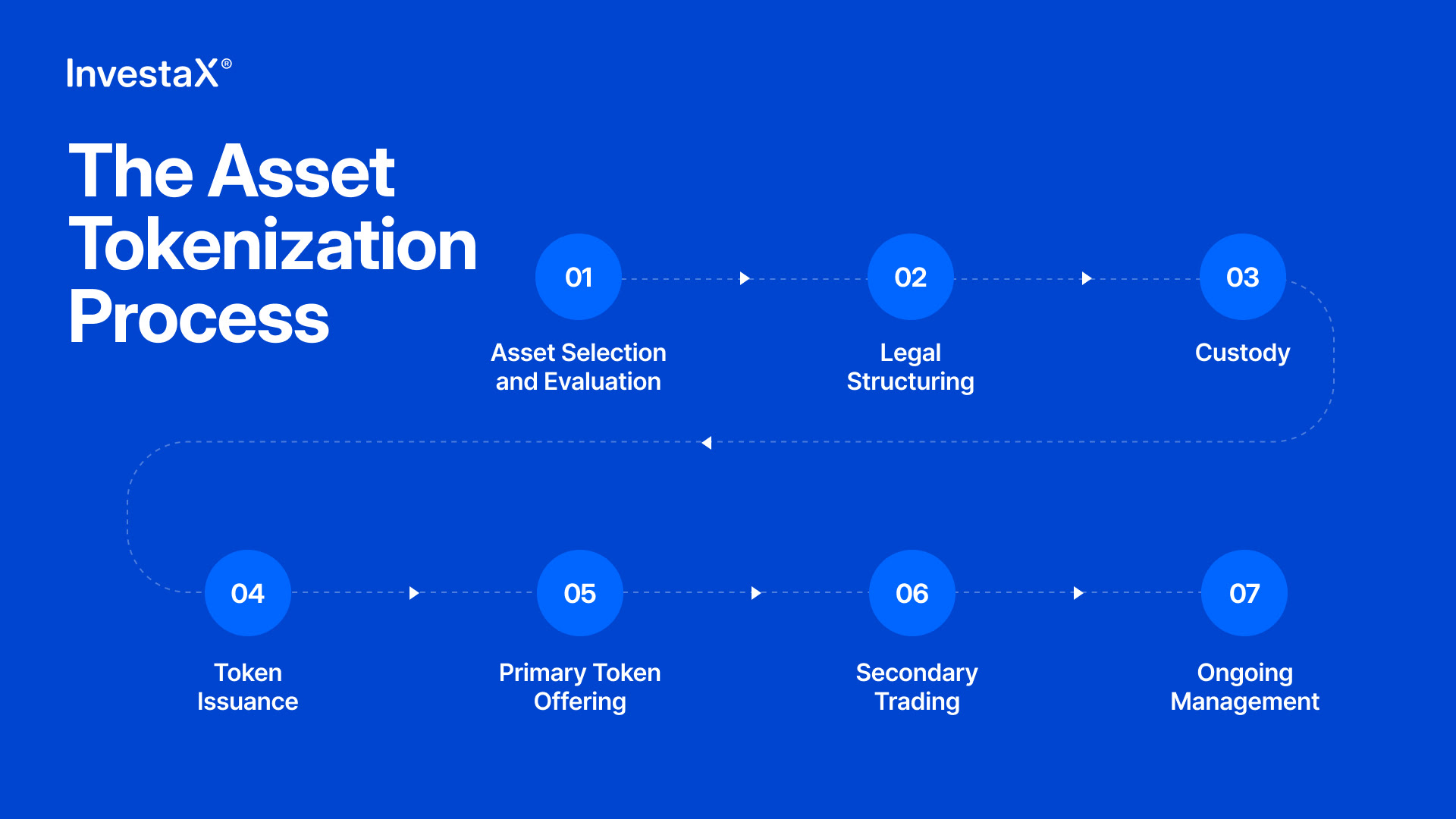
- Asset selection and evaluation: Identify the asset and assess suitability for tokenization. This includes confirming ownership, reviewing documentation, and understanding cash flow or valuation characteristics.
- Legal structuring: Choose the appropriate asset tokenization structure, such as an SPV, trust, or feeder fund, and prepare the documents that define rights, obligations, and how the token represents the asset.
- Custody of the RWA and custody of tokens: Set up custodial arrangements for both the underlying asset and the digital tokens. This includes determining how the asset is held and how wallets or custodians manage token safekeeping.
- Token issuance: Create the tokens on a regulated platform and configure compliance rules, including investor eligibility, transfer restrictions, and jurisdictional filters.
- Primary token offering: Investors complete KYC, AML, and suitability checks. Approved investors subscribe to the offering via a regulated RWA platform like InvestaX.
- Secondary trading: Where permitted, tokens can trade within controlled, compliance-aligned environments such as regulated marketplaces or issuer-approved transfer modules.
- Ongoing management: Servicing activities, such as interest payments, reporting, redemptions, and corporate actions follow established terms, with updates recorded on a unified ledger.
For issuers looking to execute this process end-to-end, an end-to-end tokenization platform with the relevant regulatory licenses can handle structuring, issuance, and secondary trading under one roof.
What Are Common Asset Tokenization Models?
Tokenized assets can be structured in several ways, depending on the underlying asset and the regulatory framework. Common asset tokenization models include tokenized SPVs, tokenized funds, tokenized debt instruments and direct asset tokenization.
- Tokenized SPVs (Special Purpose Vehicles): A legal entity (SPV) holds the underlying asset, and tokens represent fractional ownership. This structure is familiar with financial institutions as it can offer legal clarity and investor protection.
- Tokenized Funds (Feeder Funds): Tokens represent units or shares in a regulated fund or feeder structure. This model is commonly used when offering access to private funds, alternative strategies, or institutional portfolios in a digital format.
- Tokenized Debt Instruments: The token reflects the economic rights of a debt instrument such as a loan, note, invoice, or bond. This model is prevalent in the fixed income and private credit markets.
- Direct Asset Tokenization (On-Chain Assets): The asset is represented directly on-chain, and the token functions as the authoritative record of ownership for a physical or traditional financial asset.
For a detailed explanation of these structures and when each model is typically used, you can read our guide: Asset Tokenization Structures
Examples of Tokenized Funds
Tokenized funds represent traditional investment vehicles, such as money market strategies, credit products, and alternative funds, issued and administered on digital infrastructure. Below are 5 commonly referenced examples across public sources, industry reports, and regulated market deployments.
- BlackRock BUIDL (USD Institutional Digital Liquidity Fund): A tokenized cash-management fund launched on Ethereum, offering exposure to short-duration U.S. Treasuries. With over $2.3B in tokenized value as of December 2025, it is widely cited as the largest institutional tokenized fund by assets under management.
- Franklin OnChain U.S. Dollar Short-Term Money Market Fund: A tokenized money market fund (MMF) structured as a sub-fund under Singapore’s Variable Capital Company (VCC) framework. The fund provides access to stable income and capital preservation in USD through a portfolio of high-quality, short-term debt and money market instruments. The fund is available on InvestaX for qualified investors.
- Mikro Kapital ALTERNATIVE eNote™: A securitized microfinance debt instrument, tokenized and offered through InvestaX / Obligate platforms, aimed at institutional investors seeking fixed-coupon debt exposure.
- Ondo Finance OUSG (Tokenized exposure to BlackRock’s SHV ETF): OUSG is publicly tracked on rwa.xyz with $773,552,016 in tokenized value as of December 2025. It offers blockchain-based access to short-duration U.S. Treasuries and holds shares of the iShares Short Treasury Bond ETF (SHV).
- Matrixdock Short-Term Treasury Token (STBT): A tokenized representation of cash-equivalent U.S. Treasuries and reverse repos. As of December 2025, its total asset value stands at $3 million.
What Are The Benefits Of Asset Tokenization?
Asset tokenization introduces a modern infrastructure for representing, transferring, and servicing assets. The potential advantages generally relate to participation, operations, settlement, and information quality.
1. Broader entry points for investors
Tokenization allows assets to be divided into smaller units, which can lower minimum investment sizes and make certain asset classes easier to access. This can open participation to investors who may not have met traditional thresholds due to capital requirements or geographic limitations.
Regulated fractional formats let individuals hold a defined portion of an asset while maintaining the same legal protections that apply to the full instrument. This creates a more inclusive structure without altering the underlying investment terms.
2. Streamlined operational workflows
Traditional issuance and servicing often move across several systems for onboarding, compliance, registry updates, and reporting. Tokenization offers the potential to coordinate these steps within a single environment, which may reduce administrative effort and support more consistent record-keeping.
Several industry reports highlight that standardized digital workflows may help institutions reduce manual documentation, minimize reconciliation issues, and improve coordination among service providers. These improvements typically become more noticeable as asset volumes increase.
3. More predictable settlement cycles
Settlement in traditional markets can involve multiple intermediaries and reconciliation processes, which results in delays. When asset ownership updates occur directly on a distributed ledger, transfers can move more quickly and with fewer intermediaries.
This can be particularly helpful in cross-border transactions, where time zone differences and interbank processes have historically extended settlement windows. Tokenized structures provide a framework for more predictable timelines, subject to regulatory permissions.
4. Clearer visibility across the asset lifecycle
A distributed ledger acts as a shared record of ownership and transaction history. Each update is time-stamped and traceable, which supports auditability and regulatory review.
This transparency can reduce information gaps between issuers, investors, and service providers. It also strengthens risk management by providing real-time insight into asset status, movements, and compliance actions. Over time, having a single reference point for data can contribute to greater confidence in how the asset is administered.
What Are The Risks and Challenges Of Tokenized Assets?
The major risks associated with tokenized assets relate to legal clarity, technology, market structure, and reliance on service providers, according to the International Organization of Securities Commissions (IOSCO), the Bank for International Settlements (BIS), and recent academic research.
1. Legal and Regulatory Clarity
According to IOSCO’s 2024 “Decentralized Finance and Digital Assets” report, one of the primary challenges in tokenized markets is determining how existing securities laws apply to digital representations of real-world assets. IOSCO notes that legal rights attached to tokens must be clearly defined, especially regarding ownership, transferability, and investor protections.
The report “Bridging the Adoption Gap: Aligning Digital Asset Offerings with Buy-Side Requirements” (IA-IMAS, Nov 2025) similarly emphasises that legal and regulatory certainty remains one of the most significant determinants of investor confidence. Its industry survey found that institutional investors consider unclear legal treatment, inconsistent regulatory frameworks, and cross-border fragmentation major barriers to adoption (page 26).
Today, regulatory models still differ across regions. Frameworks tend to fall along a spectrum that ranges from traditional securities integration (U.S.), to hybrid digital-asset approaches (Singapore, Hong Kong, Australia), to sandbox-led experimentation (UK, UAE). This evolving environment requires issuers and investors to navigate varying rules on custody, investor rights, disclosures, and transfer restrictions.
2. Technology and operational considerations
According to IOSCO’s Decentralized Finance and Digital Assets report, tokenized markets introduce technology-related considerations such as smart contract vulnerabilities, cyber risks, and the need for secure key management.
The IA-IMAS report expands on this by highlighting gaps in integration between on-chain and off-chain systems. Many fund administrators, custodians, and distributors remain unable to process tokenized transactions seamlessly within existing infrastructure. Survey respondents cited:
- limited reconciliation tools,
- fragmented platform standards, and
- insufficient operational training across legal, compliance, and middle-office teams as factors that make onboarding tokenized assets more complex.
3. Liquidity and market-structure limitations
Tokenization can improve how assets are serviced, distributed, and recorded. But it doesn’t transform the economic fundamentals of the asset itself. If the underlying asset lacks investor demand, digital wrappers will do little to change that. A 2025 academic analysis published on arXiv found that, despite over USD 25 billion in tokenized RWAs brought on-chain, most tokenized assets continue to exhibit low trading volumes, long holding periods, and limited secondary-market activity.
4. Custody and safekeeping arrangements
The joint report “Bridging the Adoption Gap: Aligning Digital Asset Offerings with Buy-Side Requirements” by the IA and IMAS highlights custody as a central challenge. Traditional custodians are still building capabilities to support digital wallets, smart contract governance, and interoperability with tokenization platforms.
Investors also seek clarity on:
- whether tokenized assets are recognised as property,
- how custody rights are preserved in insolvency,
- the responsibilities of custodians regarding private keys, and
- how reconciliation is performed across on-chain and off-chain systems.
These uncertainties can create hesitation among fiduciary investors who rely on well-established custody frameworks.
What is The Difference Between RWA and Crypto-Native Tokens?
The key difference is that tokenized real-world assets (RWAs) represent claims on an underlying regulated asset, while crypto-native tokens do not. RWA tokens typically fall within securities classifications because they reflect ownership, economic rights, or claims linked to some financial instrument. Crypto-native tokens are created directly on a blockchain and do not correspond to an off-chain financial instrument.
RWA (real-world asset) tokens
- Represent an interest in a real asset such as credit instruments, fund units, real estate, gold, or commodities.
- Value is supported by the underlying asset and the legal structure that defines investor rights.
- Typically require compliance, regulated custody, and clear documentation.
- Are often classified as security tokens
Crypto-native tokens
- Exist purely on-chain, with no claim on an external asset. Examples include ETH, SOL, UNI, and governance or utility tokens used within protocols.
- Value is driven by network activity, use cases, governance roles, or market demand.
- Regulatory treatment varies and often differs from frameworks used for tokenized assets.
- Are often classified as utility tokens.
A simple way to differentiate them
- RWA tokens are blockchain-based representations of something that already exists in traditional finance.
- Crypto-native tokens originate on-chain and have no direct link to a physical or financial asset.
For a deeper comparison, you can refer to our article comparing utility tokens and security tokens.
Is a License Needed For Real-World Asset Tokenization?
A license is often required for real-world asset tokenization because many tokenized products fall within existing securities frameworks. The specific obligations depend on the asset being tokenized, the structure used, and the jurisdiction in which the activity takes place.
In practice, tokenization does not change the regulatory nature of a product. If an asset is treated as a security offline, it will typically be treated as a security once tokenized.
Why licensing matters?
Tokenization does not change the legal nature of the underlying asset. If the product is a security offline, it will typically be treated as a security once tokenized.
This means issuers, platforms, and intermediaries may need to meet the same regulatory expectations applied to traditional capital-markets activity.
Licensing can provide:
- A defined framework for investor protection
- Rules for custody, segregation, and safekeeping
- Oversight of issuance, distribution, and secondary transfers
- Clarity on disclosure and reporting obligations
- Standards for handling client money and assets
Regulators globally have reiterated the principle of “same activity, same risk, same regulatory outcome,” which guides how tokenized securities frameworks are being implemented across major financial hubs.
Important Clarification
Not all tokenized real-world assets are classified as securities. Classification depends on the nature of the underlying asset, the token’s structure, and the regulatory definitions used in each jurisdiction. Some authorities focus on the economic rights embedded in the token, while others look at the legal form or functional characteristics.
However, when a tokenized RWA meets the criteria for a security, the related issuance, custody, and trading activities generally fall within licensing regimes. Assessing this classification early helps ensure that the token operates within the appropriate regulatory framework.
In the sections below, we outline various asset types and the channels through which investors can access them, along with our insights into the associated licensing and regulations.
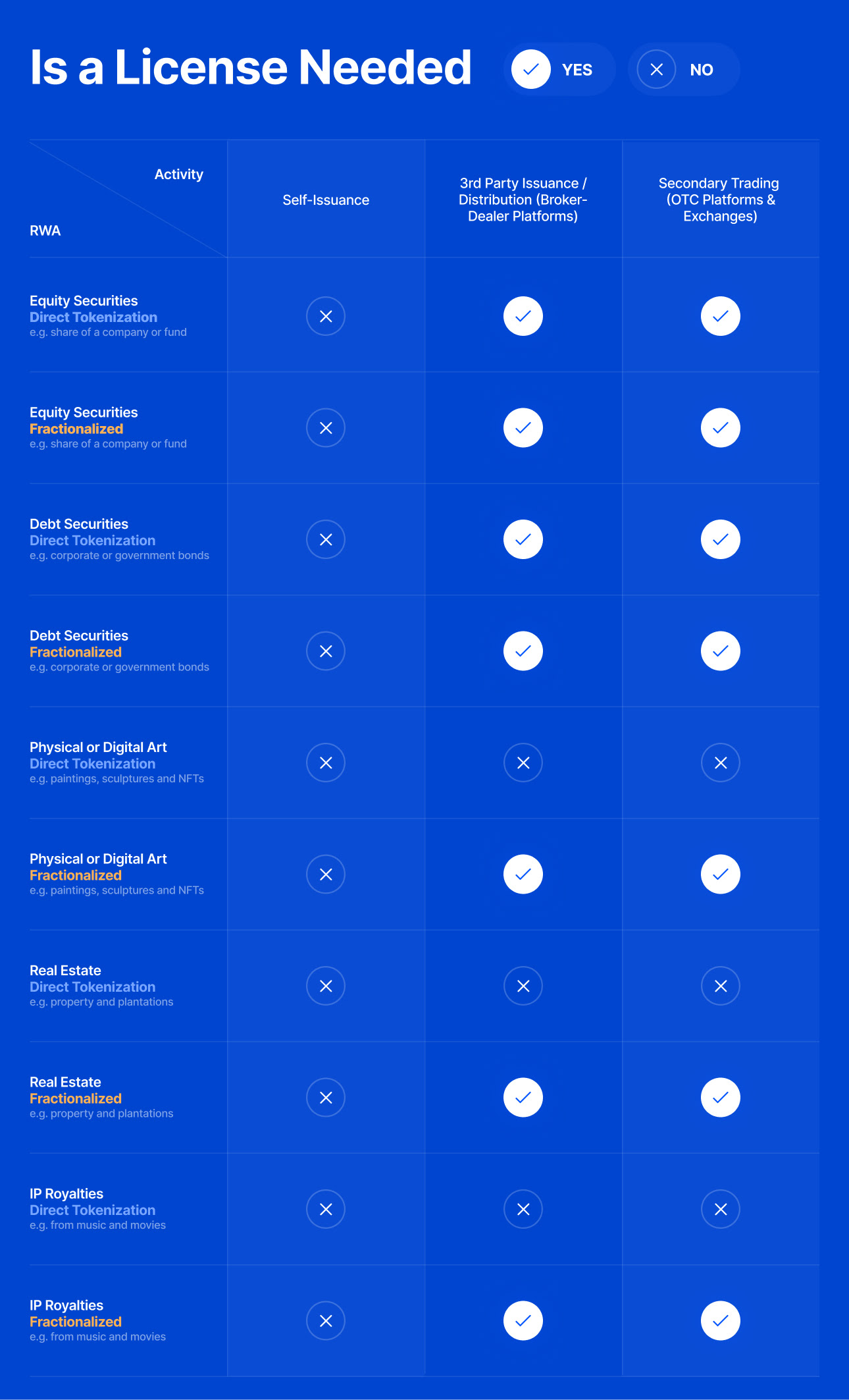
For a detailed breakdown of licensing requirements across jurisdictions and activity types, see our full guide: Real-World Asset Tokenization: Is a License Needed?
How Does Secondary Trading Work for RWAs?
Secondary trading for tokenized real-world assets (RWAs) typically takes place within regulated, permissioned environments where transfers are controlled by compliance rules such as investor eligibility, jurisdiction, and holding restrictions. The process resembles traditional private-market transfers, but blockchain infrastructure can make the workflow more structured and transparent. Regulators such as IOSCO highlight that secondary trading for digital securities must reflect the same investor-protection rules that apply offline.
How trading usually works
Most regulated RWA platforms use a model where each investor must complete KYC, AML, and suitability checks before they can buy or sell. Once approved and whitelisted, an investor can trade within the boundaries of the asset’s legal and regulatory framework.
A transfer can only settle if the rules encoded in the smart contract are met. These rules may include:
- investor eligibility requirements
- jurisdiction limits
- holding period restrictions
- restrictions on the number or type of permissible transferees
This structure helps issuers ensure that every transfer remains compliant without running manual checks for each transaction.
What the market looks like today
The 2025 arXiv study, which examined more than USD 25 billion in tokenized RWAs, also found that many tokenized instruments exhibit low secondary-market depth, even as overall tokenized RWA issuance surpassed 25 billion dollars. Liquidity tends to be higher in categories where investors already expect shorter holding periods, such as tokenized U.S. Treasuries or certain private credit pools.
Final Note
Real-world asset tokenization is steadily becoming part of mainstream financial infrastructure. Its value lies in applying digital tools to established regulatory frameworks, creating the potential for more consistent servicing, greater transparency, and clearer operational workflows. For issuers or managers exploring digital issuance, working with licensed providers offers a more reliable path to deployment and ongoing administration.
If you are considering tokenizing assets, you can contact InvestaX to explore regulated pathways and implementation options.