The year 2025 is recognized as the critical transition point where Real-World Asset (RWA) tokenization moved from a niche concept to a foundational layer for regulated digital finance. RWA tokenization is the process of converting rights to a physical or traditional financial asset into a verifiable digital token on a distributed ledger.
The primary momentum behind the trend of RWA tokenization is the necessity for greater capital efficiency, a mechanism for shorter settlement cycles, and the demand for compliant yield tied to high-quality assets. The market is now clearly prioritizing platforms that are licensed and compliance-first.
Market Snapshot: Fixed Income Drives Adoption
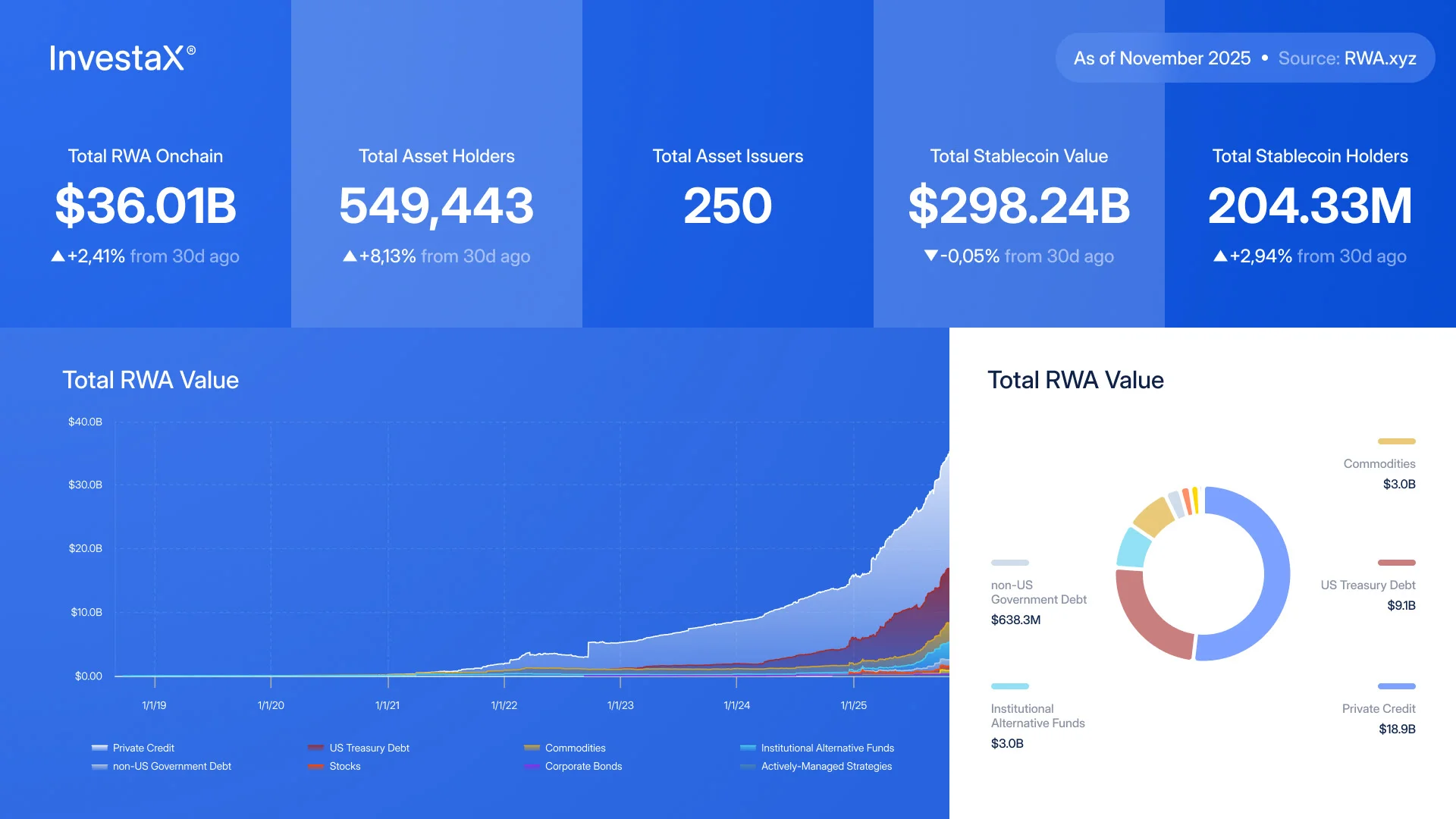
According to RWA.xyz, tokenized RWAs grew to over $35 billion in total value by the end of November 2025, showing just how fast institutions are moving into this space. Other data sources, like RWA.io, place the market capitalization even higher at $50.14 billion. While the exact numbers vary depending on how the data is counted, the trend is undeniable: tens of billions of dollars in real assets are now living on the blockchain.
What Asset Classes Have Been Tokenized?
A wide range of asset classes have been tokenized. They are generally organized into three core categories that highlight the primary value unlocked by distributed ledger technology (DLT):
- Financial Assets. These include securities and instruments previously managed via conventional ledger systems, where tokenization fundamentally improves settlement time and transparency. The majority of 2025 market activity focused here, encompassing U.S. Treasuries, corporate bonds, public equity (tokenized stocks/ETFs), and non-U.S. government debt.
- Real Assets. For tangible, physical assets, such as real estate, gold, and other commodities, tokenization delivers fractionalization and enhanced liquidity to traditionally illiquid holdings. Because these assets exist off-chain, their legal title and physical custody are typically held by licensed custodians or a Special Purpose Vehicle (SPV).
- Alternative Assets. This category comprises non-conventional or complex assets, utilizing tokenization to provide programmatic access to revenue streams and improved fungibility. Examples include carbon credits, intellectual property (IP) rights, and institutional alternative funds.
Beyond these defined asset classes, sectors with complex cash-flow rights and intense audit needs are actively testing tokenization for better data integrity and lifecycle management:
- In China, AntChain tokenized $8.4 billion in carbon-neutral energy assets, showcasing tokenization’s role in industrial ESG strategies.
- In Japan, Mitsubishi UFJ Trust and Banking, the trust division of MUFG, plans to tokenize real estate and distribute these tokenized real estate units to both retail and institutional investors.
- In Singapore, OCBC offer tokenized bonds to corporate accredited investors, lowering minimum investment thresholds from the usual S$250,000 to S$1,000.
- IVD Medical and Transcenta launched a pilot to tokenize pharma R&D assets and drug cash flows, marking an early attempt to apply tokenization in the life sciences sector.
- Asset manager GuoFu Quantum has launched a tokenized investment fund under Hong Kong’s regulatory framework.
This breadth of product development is tracked by major external platforms. According to RWA.io, debt, equity, funds, real estate, commodities, and carbon credits have been tokenized. Meanwhile, RWA.xyz reports metrics for U.S. treasuries, commodities, private credit, institutional alternative funds, public equity, non-U.S. government debt, and corporate bonds on the list.
What Asset Classes Dominate RWA Tokenization?
While tokenized finance extends to many sectors, the market is showing a clear preference for instruments that merge traditional familiarity and stability with the technological efficiencies of a distributed ledger. This establishes where institutional capital is primarily flowing and who is deploying it.
- Private Credit Dominance: This category holds over $18.91 billion in active value as of November 2025, representing institutional demand for high-yield, short-duration investment strategies. This drive is evidenced by organizations like Apollo Global Management launching tokenized funds with partners like Securitize.
- Treasuries and Money Market Funds (MMFs): These instruments, exceeding $9 billion in tokenized value, function as the regulated on-chain alternative to traditional money market products. The deployment of significant institutional capital into these funds, such as BlackRock’s BUIDL fund surpassing $2 billion in assets, indicates that major asset managers view tokenization as a foundational technology.
Who Is Driving Tokenized Asset Issuance Volume?
Issuance volume is largely concentrated among regulated financial institutions namely BlackRock, Fidelity, and Franklin Templeton. This volume is driven by a strategy to apply the stability of traditional assets to the speed and programmability of blockchain rails.
Key Institutional Issuers and Strategic Moves in 2025
- BlackRock: Launched the BUIDL fund, which is tokenized U.S. Treasuries, now secures nearly $2 billion in assets.
- Franklin Templeton: Launched the Franklin OnChain U.S. Dollar Short-Term Money Market Fund on InvestaX, expanding the global leader’s footprint in the digital asset ecosystem through regulated distribution.
- JPMorgan Chase: Tokenized a private-equity fund for select clients on its proprietary Kinexys platform, streamlining PE fund subscription and custody. JPM's Tokenized Collateral Network (TCN) is used by firms like BlackRock and Fidelity to post tokenized MMF shares as collateral.
- Fidelity: Entered the tokenized yield space with a tokenized interest product - the Fidelity Digital Interest Token (FDIT). According to RWA.xyz, the fund normally invests at least 99.5% of total assets in cash and U.S. Treasury securities.
- Apollo Global Management: Apollo Asset Management, another veteran asset manager with $840 billion of assets under management as of June 30, 2025, announced the launch of a tokenized private credit fund on 6 blockchain networks.
- Societe Generale: Issued its first U.S. Digital Bond on blockchain, demonstrating the technology's application in cross-border debt issuance.
- Siemens: Issued a €300 million corporate bond on-chain, showcasing the tangible benefits of streamlined issuance and settlement for large corporations.
What Drives Institutional Adoption?
The primary momentum behind this institutional commitment is the necessity for greater capital efficiency, a mechanism for shorter settlement cycles, and the demand for compliant yield tied to high-quality assets. Plus, the expanded use cases enabled by on-chain ecosystem is another factor encouraging tokenized asset issuance.
- New Distribution Pathway: Tokenization introduces a new distribution channel on the blockchain rail, in addition to the traditional pathway. For instance, issuers can reach global investors via the InvestaX MAS-licensed RWA platform.
- Settlement Velocity: Tokenization facilitates moving toward near-instantaneous, simultaneous settlement (Delivery versus Payment, or DvP). This immediacy substantially minimizes counterparty risk compared to the multiple-day settlement windows in conventional systems.
- Compliant Yield: There is growing institutional demand for returns derived from traditional, predictable financial assets, often structured on-chain. This focus allows asset managers to deliver yield while maintaining alignment with client and regulatory compliance mandates, avoiding reliance on speculative crypto market protocols.
- Expanded Asset Productivity: Tokenization unlocks new structural possibilities for assets once restricted by illiquidity or manual processes. A prime example is the use of tokenized funds, like BlackRock's BUIDL, as collateral on major Binance, Crypto.com, and Deribit.
Tokenized U.S. Stocks On The Rise
Tokenizing U.S. stocks represents the next major goal for applying blockchain efficiency to public markets. The market capitalization for these digital assets was roughly $424 million by mid-2025 (according to RWA.xyz), but its potential scale is projected to surpass $1 trillion as institutional adoption grows.
The primary drivers for tokenizing equity are clear and focused on removing traditional friction points:
- 24/7 Trading: Tokenization enables round-the-clock dealing, eliminating the constraints of conventional market hours.
- Fractional Ownership: Assets can be divided into smaller, affordable units, allowing investors to buy fractions of high-value stocks with minimal capital.
- Global Access: It solves common hurdles like complex broker access and FX inefficiencies for international investors, particularly in regions like Asia and Africa.
- Instant Settlement: Trades can be settled instantly, significantly reducing counterparty risk in the transaction life cycle.
This efficiency is now moving from crypto platforms to regulated exchanges:
- In June 2025, Kraken launched xStocks, bringing tokenized versions of 60 U.S. equities and ETFs on-chain, and integrating them with Solana-based DeFi protocols.
- By September, Nasdaq made a significant move by filing a proposal with the SEC to allow trading of listed stocks in tokenized form, signaling the integration of DLT into core U.S. market infrastructure.
- In October, Blockchain.com and Ondo Finance partnered to launch tokenized U.S. equities for retail investors in Nigeria, bridging international users to American markets via stablecoins.
- Other major platforms like Robinhood and Gemini also expanded their suites, with Robinhood deploying over 200 tokenized stock and ETF products for the European market to meet the growing demand for 24/7 fractional ownership.
- The New York Stock Exchange (NYSE) followed in early 2026 by announcing plans to build its own 24/7 tokenized securities trading platform. The NYSE aims to offer a new venue for continuous trading of tokenized U.S. equities and ETFs, powered by stablecoin-based funding.
The underlying legal reality should be noted: tokenized securities are still securities and are subject to SEC and international rules. Scalable, compliant adoption requires permissioned tokens that embed regulatory standards directly into the token's smart contract logic. This ensures the asset retains full shareholder rights and enables robust compliance across the global ecosystem.
In an interview with Bloomberg Television, SEC Commissioner Hester Peirce reaffirmed that tokenized securities remain subject to traditional securities laws, emphasizing that blockchain-based innovation must operate within regulated frameworks. This highlights the critical importance of licensed infrastructure like InvestaX for compliant issuance and trading of RWAs.
SEC's Pierce on Tokenization of Securities
Asset-Backed BTC Yield: Unlocking Collateral Productivity
A key area of focus for institutional investors is transforming their large, passive asset holdings into sources of income. Bitcoin, for example, has a market capitalization exceeding $1.8 trillion (as of December 2025). Despite public firms and institutions Tesla, Metaplanet, and Coinbase holding millions of BTC, the asset typically generates no intrinsic return when held passively in a wallet.
This has led to the emergence of highly structured products such as IXS BTC Real Yield that merge blue-chip digital assets with regulated RWA fixed income. These allow holders to pledge BTC as collateral for non-recourse loans, with proceeds deployed into regulated RWAs like U.S. Treasuries. This structure generates steady, USD-denominated yield (typically 4–8%) by linking digital assets to real economic activity, solving the "dormant collateral" problem without relying on speculative DeFi protocols.
This approach transforms a passive store of value into an income-generating asset, providing a regulated, scalable solution for institutional treasuries seeking asset productivity.
Regulatory Landscape: The Foundation for Institutional Scale
Institutional adoption of tokenization has been directly enabled by a fundamental shift in the global regulatory posture. Jurisdictions globally are pursuing distinct paths, but most share a similar view: "Tokenized securities are still securities.” This means the regulatory focus is on the function of the tokenized asset (e.g., security, payment instrument), not the underlying technology.
Common approaches by regulators include:
- Integration into Existing Law
The U.S. approach emphasizes integrating tokenized instruments into existing securities law frameworks. SEC Chair Paul Atkins, in advancing "Project Crypto," reaffirmed that a tokenized security is still a security and must be subject to SEC rules. He noted that being "on-chain" provides the necessary transparency for T+0 settlement efficiency. This policy direction points toward facilitating the tokenization of stocks, bonds, and other securities under tailored, modernized rules.
According to PwC Global Crypto Regulation Report 2025, “Institutional investors are beginning to enter the market at an accelerated pace due to the SEC’s new framework on digital asset securities, clarifying the classification and treatment of tokenized assets.”
- Supervised Experimentation
Asia-Pacific jurisdictions tend to prioritize supervised experimentation through collaborative pilots. Singapore, via Project Guardian, published an Operational Guide for Tokenized Funds to give fund managers and service providers a shared, compliant framework for asset servicing, governance, and NAV calculation. Meanwhile, Hong Kong's Fintech 2030 roadmap accelerates RWA tokenization by regularizing the issuance of tokenized government bonds and exploring public-blockchain settlement.
- New Unified Frameworks (EU Focus)
The European Union has established a two-pillar regulatory framework that provides legal clarity for all asset types:
- Tokenized Securities (MiFID II): Assets that qualify as financial instruments, such as tokenized stocks, bonds, and derivatives, remain governed by MiFID II. This ensures they adhere to the same robust investor protection and market integrity standards as traditional securities.
- Non-Security Tokens (MiCAR): The fully operational Markets in Crypto-Assets Regulation (MiCAR) creates a unified rulebook for crypto-assets not covered by existing financial services legislation. This includes asset-referenced tokens (stablecoins) and utility tokens, reducing complexity for cross-border services across member states.
Complementing this EU-wide framework, individual member states have enacted progressive national laws to support blockchain-native issuances:
- Germany introduced the Electronic Securities Act (eWpG), enabling the issuance of bearer bonds and fund units on distributed ledgers without requiring a physical certificate.
- Luxembourg advanced its "Blockchain Laws," which strengthens the legal framework for blockchain in the financial sector and marks a significant step in the use of distributed ledger technology (DLT) for the issuance of securities.
Regulatory clarity provides the essential legal certainty required for capital to move at scale. As the market evolves, we expect to see further regulatory developments that will continue to open the way for broader adoption.
Top RWA Tokenization Reports to Read in 2025
With RWA tokenization shifting to adoption, challenges around custody, liquidity, compliance, and market structure arise. These reports offer reference points for tracking market development.
1. RWA.io – State of RWA Tokenization 2026
This report - developed by RWA.io, in collaboration with Coinbase, Polygon Labs, Franklin Templeton, Chainlink Labs, and others, highlights a market that has reached $36 billion, marking a 2,200% growth since 2020. It explores how US Treasuries and private credit reached "critical mass" in 2025, shifting the industry from a distant vision to a structural reality that is actively redefining global capital market liquidity. Read report
2. PwC – Global Crypto Regulation Report 2025
PwC provides a comprehensive map of the evolving regulatory landscape across major financial hubs. The report is a vital resource for understanding how new licensing frameworks are providing the legal certainty necessary for institutional players to issue and trade digital assets globally. Read report
3. OECD – Tokenisation of Assets and DLT in Financial Markets
The OECD analyzes the policy considerations for regulators, identifying current barriers to market scale. It offers a deep dive into how distributed ledger technology can improve market efficiency while highlighting the specific regulatory "pain points" that still need to be addressed to achieve full interoperability. Read report
4. CFA Institute – An Investment Perspective on Tokenization (Part I)
Written from an investor’s lens, the CFA Institute explores how tokenization specifically benefits private markets. It details how on-chain structures can reduce traditional lockup periods, lower entry barriers, and provide investors with enhanced transparency and fractional ownership of high-value assets. Read report
5. IMMFA – Money Market Fund Tokenisation Whitepaper
The Institutional Money Market Funds Association (IMMFA) examines the rise of tokenized MMFs. This whitepaper explains why MMFs have become the "killer app" for RWAs, offering stablecoin-native yield and real-time collateral mobility for institutional treasurers. Read report
Looking Ahead: What Opportunities and Challenges
As the RWA market moves from a testing phase to essential infrastructure, the focus shifts to scaling foundational technologies and navigating residual market hurdles.
Opportunities: Scaling Productivity and Access
The multi-trillion dollar opportunity remains the core driver for innovation in tokenization. The growth trajectory for 2026 and beyond is supported by three primary opportunities:
- New Source of Capital: Crypto-native investors currently represent one of the most active client segments on tokenized exchanges, expecting real-time execution and settlement. This group, along with over $300 billion in on-chain stablecoin capital that currently earns no native yield, represents a significant new source of capital for issuers. Tokenizing yield-bearing assets like U.S. Treasuries and Money Market Funds provides a pathway to capture this liquidity while meeting the demand for instant, intuitive investment experiences.
- Monetizing Digital Collateral: The convergence between RWA and blue-chip digital assets creates immense opportunity for asset productivity. With Bitcoin alone representing a multi-trillion dollar asset class, the demand for compliant yield solutions is exponential. Products like the IXS BTC Real Yield model, which seamlessly connect dormant Bitcoin collateral to regulated fixed-income returns, represent a major scalable solution for institutional treasuries.
- Enabling Faster Settlement: The institutional adoption of regulated on-chain money, including central bank digital currency (CBDC) pilots (like Project Helvetia) and tokenized deposit initiatives, will accelerate. This rise in regulated digital cash is necessary to enable true DvP settlement at scale, thereby eliminating counterparty risk and freeing up liquidity across the financial system.
Challenges: Navigating Structural Hurdles
On 12 November 2025, the Investment Association (IA) and the Investment Management Association of Singapore (IMAS) released a joint report “Bridging the Adoption Gap: Aligning Digital Asset Offerings with Buy-Side Requirements” examining the evolving landscape of tokenized asset markets. Developed with input from the Monetary Authority of Singapore (MAS) and the UK Financial Conduct Authority (FCA), the report identifies that while interest is high, the market faces distinct barriers in commercial viability, operational complexity, and regulatory alignment.
To move from pilot phases to global scale, the industry need to address four critical challenges:
- Standardization and Interoperability: As institutions build out their capabilities, there is a strong industry push to prevent the formation of "digital silos." The MAS advocates for a model of "co-opetition," where platforms agree on common technical standards. The goal is to ensure that a token issued on one network can move seamlessly to another, creating a unified global marketplace rather than fragmented "walled gardens".
- Limited Liquidity and Settlement Depth: Scaling a market requires deep pools of trusted capital. For instant settlement (DvP) to become the standard, the ecosystem is expanding its roster of reliable on-chain settlement assets. This involves maturing the infrastructure for regulated stablecoins and tokenized commercial bank deposits, ensuring they offer the same finality and safety as central bank money.
- Operational and Educational Barriers: A natural learning curve exists as traditional investors adapt to digital wallets and key management. The challenge for platforms is to abstract this complexity, making the user experience intuitive for non-technical clients. Simultaneously, institutions are investing in integrating on-chain systems with their legacy IT, moving from isolated innovation pilots to full organizational readiness.
- Harmonizing Global Frameworks: While domestic regulations are becoming clearer, the focus is now on cross-border alignment. Institutions are looking for greater consistency in how custody, insolvency, and token rights are treated across different jurisdictions. As international coordination improves, it will provide the legal certainty needed for assets to flow freely across borders without compliance friction.
These hurdles are natural in an emerging market. Proactively addressing them now facilitates a robust foundation, paving the way for the ecosystem to evolve and scale globally.
Tokenize Assets with InvestaX
InvestaX is a leading institutional-grade platform specializing in the compliant tokenization and distribution of real-world assets (RWAs) globally. Regulated by the Monetary Authority of Singapore (MAS), InvestaX enables financial institutions and asset managers to compliantly issue, manage, and trade tokenized RWAs across a network of fintech platforms, exchanges and distribution partners. Contact us to tokenize real world assets.