Published: April 2026 | By InvestaX
The first quarter of 2026 brought something the RWA tokenization market has been building toward for several years: infrastructure-level commitments from the institutions that run global capital markets. Nasdaq, the NYSE, and the DTCC all moved in the same direction, toward integrating tokenized securities into the existing architecture of regulated markets.
According to RWA.xyz, the total value of tokenized real-world assets on-chain grew from approximately $21 billion at the start of the year to around $27.5 billion by the end of Q1, a 30% increase in three months. That pace, sustained over a full quarter, signals institutional momentum rather than a single headline event.
Key takeaways from the first quarter of 2026:
- Total tokenized RWA value on-chain: ~$27.5B, up from ~$21B at the start of the year (RWA.xyz)
- Tokenized U.S. Treasuries surpassed $10B in late February and have grown to $13.4B as of early April
- Tokenized commodities reached $7.3B, driven largely by gold
- The SEC issued its first formal statement on tokenized securities in January, approved WisdomTree's tokenized MMF intraday trading in February, and released joint guidance on digital asset taxonomy with CFTC in March, three sequential moves that together define the U.S. market structure direction for the year.
- NYSE and Nasdaq are both building 24/7 tokenized securities infrastructure, with different architectural approaches
- BlackRock's BUIDL fund entered DeFi rails via Uniswap, the first time a major asset manager connected a regulated tokenized fund to a decentralised exchange
- Franklin Templeton partnered with Ondo Finance to launch tokenized versions of five ETFs, tradeable 24/7 via crypto wallets
- Galactica completed bridge financing for a 145,000 CBM LNG vessel via InvestaX’s MAS-licensed platform.
- IXS launched the early access for the first regulated RWA investment layer purpose-built for AI agents
Market Snapshot: Q1 2026 by the Numbers
The tokenized RWA market (excluding stablecoins) grew approximately 30% in Q1 2026, reaching around $29 billion in total on-chain value according to RWA.xyz. This compares to roughly $7.9 billion in 2024 is a 263% increase year over year.

Capital tends to flow toward instruments that fit within existing institutional workflows: government securities, money market funds, private credit, and increasingly gold-backed commodities.
Tokenized U.S. Treasuries: crossing $13B
Tokenized U.S. Treasuries ended Q1 as the largest tokenized asset class and the fastest-growing segment of the quarter. Total value surpassed $10 billion in late February and reached $13.4 billion by early April according to RWA.xyz.
This is a meaningful increase from the $9.6 billion figure at the end of 2025. Growth was driven by continued inflows into established products: Circle's USYC ($2.7B), BlackRock's BUIDL ($2.4B), Ondo's suite ($2.6B), Franklin Templeton's BENJI ($1.0B), and WisdomTree's WTGXX ($861M).
Tokenized Treasuries offer yield-bearing alternatives to idle stablecoins, with the added advantage of on-chain composability: the tokens can serve as collateral in lending protocols, be posted as margin, or be transferred between counterparties without reverting to fiat.
Tokenized commodities: gold leads
Tokenized commodities reached $7.3 billion in market capitalization as of early April, making it the third-largest tokenized asset class after private credit and U.S. Treasuries. Precious metals, especially gold accounts for the substantial majority of this figure, reflecting sustained demand as gold prices continued rising through Q1.
The quarter also saw new tokenized product development in the space. HSBC's Hang Seng Investment announced plans to launch a gold ETF with tokenized shares. Hong Kong's HashKey Chain supported the territory's first regulated silver-backed RWA token. These moves point to commodity tokenization broadening from gold into other metals.
Tokenized stocks approaching $1B
The tokenized equity market reached approximately $960 million by March 2026 according to RWA.xyz, up significantly from around $424 million at mid-2025. Ondo Finance holds roughly 60% of this market through its Global Markets platform. The Q1 regulatory approvals detailed in the section below could open the segment considerably over the next two to three quarters.
Tokenized real estate gaining ground
Tokenized real estate moved from pilot to live product in several markets during Q1. Hong Kong's SFC approved its first real estate tokenization products from Derlin Holdings. Dubai's Land Department launched the second phase of its real estate tokenization project in February, opening secondary market resale of tokenized property units from February 20. These are regulated markets moving from sandbox to production.
The Regulatory Story of Q1: A Sequential U.S. Build
One of the most significant regulatory developments in Q1 was a sequence of U.S. regulatory decisions that, taken together, signal a clear direction.
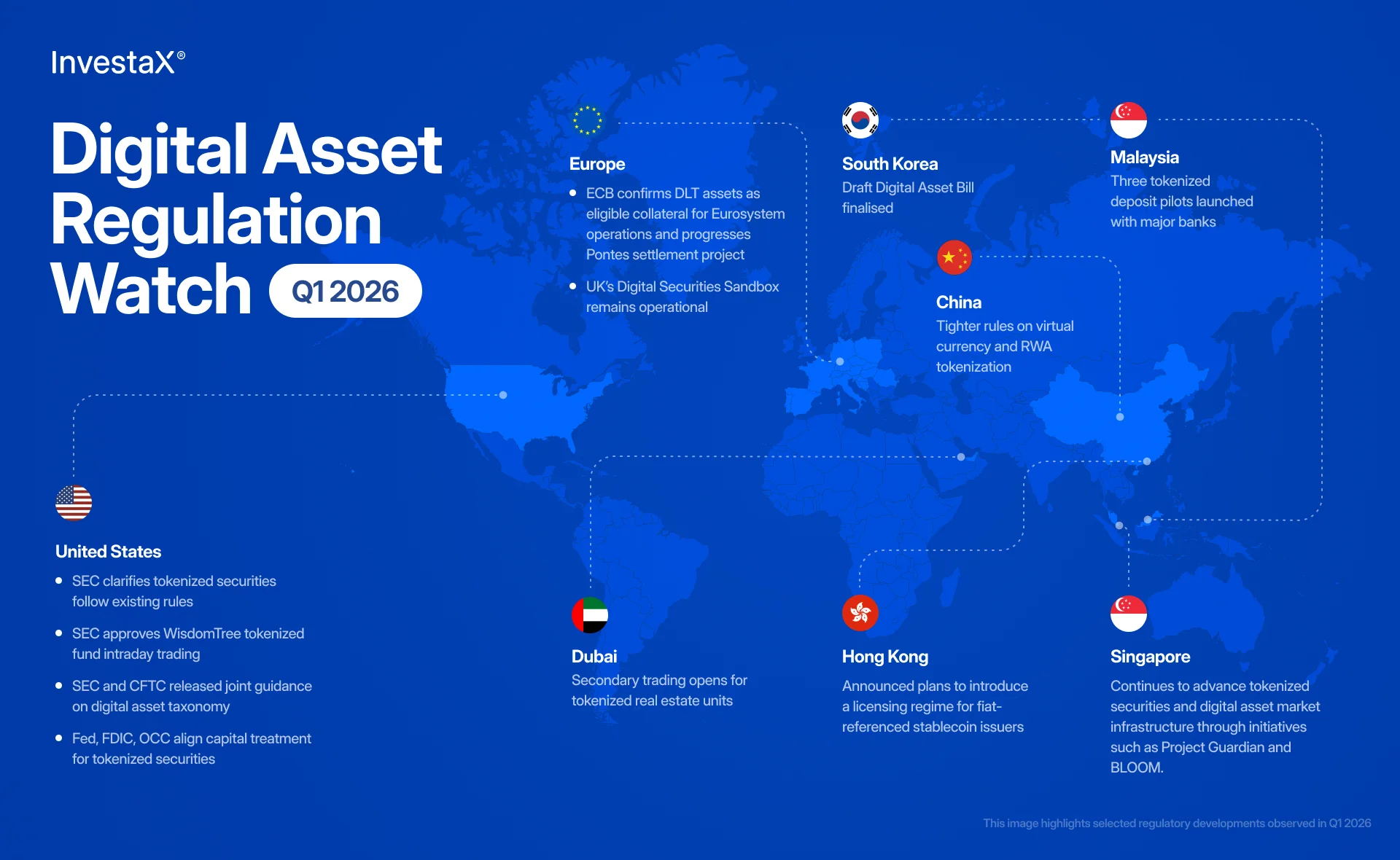
January: the SEC defines the territory
On January 28, the SEC's Division of Corporation Finance issued its first formal statement on tokenized securities. The statement clarified that tokenized securities are securities, subject to the same rules that govern traditional instruments, and that the regulatory framework applies based on the economic function of the asset rather than its technological format.
In the EU, ECB confirms distributed ledger technology (DLT) assets as eligible collateral for Eurosystem operations and progresses Pontes settlement project. According to ECB’s press release, Eurosystem will accept marketable assets issued in central securities depositories (CSDs) using DLT as eligible collateral for Eurosystem credit operations as of 30 March 2026.
February: the first tokenized fund gets intraday trading rights
On February 23, the SEC approved intraday trading for WisdomTree's Treasury Money Market Digital Fund (WTGXX), allowing investors to trade at a fixed $1 intraday price with a dealer, rather than only at end-of-day net asset value. FINRA separately approved WisdomTree Securities as a broker-dealer for principal trading of the tokenized money market fund shares.
This is the first time a tokenized mutual fund has been approved for T-instant settlement in the United States. The fund now trades and settles in real time, with continuous dividend accrual based on wallet holding timestamps, USDC settlement on Ethereum, and 24/7 availability. The approval provides a model that other tokenized fund managers can reference in their own applications.
March: Digital asset classification and bank capital clarity
In early March, the Federal Reserve, FDIC, and Office of the Comptroller of the Currency issued joint guidance confirming that tokenized securities receive the same capital treatment as traditional equivalents, removing additional capital uncertainty for banks.
Also in March, the SEC and CFTC issued joint guidance providing greater clarity on the classification of digital assets as securities or commodities. The guidance separates digital assets into 5 distinct categories: Digital commodities, digital collectibles, digital tools, stablecoins, and digital securities.
In the same month, Senator Cynthia Lummis confirmed that the Senate Banking Committee will mark up the Digital Asset Market Clarity Act in the second half of April. The bill aims to establish a framework for classifying digital assets as commodities or securities.
Asia-Pacific and MENA: parallel frameworks developing
In Asia:
- Singapore continues to advance tokenized securities and digital asset market infrastructure through initiatives such as Project Guardian and BLOOM.
- In February 2026, Hong Kong announced plans to introduce a licensing regime for fiat-referenced stablecoin issuers. In April, the Hong Kong Monetary Authority granted the first two licenses to a Standard Chartered joint venture and HSBC.
- Malaysia's Bank Negara Malaysia launched three tokenized deposit initiatives in 2026, onboarding Standard Chartered, Maybank, and CIMB to test ringgit-linked stablecoins and tokenized deposits for wholesale and cross-border payment use cases, with regulatory clarity on ringgit stablecoins targeted for end-2026.
- South Korea finalised its draft Digital Asset Bill, advancing the country's regulatory framework toward a structured treatment of tokenized securities.
- China announced tighter rules around virtual currency and RWA tokenization, reflecting a desire to regulate the space more closely.
In the Middle East, Dubai's Land Department launched the second phase of its real estate tokenization project in February, enabling secondary market resale of tokenized property units. The phased approach, pilot then secondary market, offers a useful model for how other jurisdictions might sequence the introduction of tokenized real assets.
Traditional Finance Builds the Rails for Tokenized Securities
NYSE and Nasdaq: two approaches to the same destination
The New York Stock Exchange (NYSE) announced it is building a dedicated 24/7 tokenized securities venue with on-chain settlement and stablecoin support. This approach is designed for continuous, around-the-clock trading with direct on-chain settlement.
Meanwhile, Nasdaq got SEC’s approval to allow certain securities to trade in tokenized form. Eligible participants, covering Russell 1000 stocks and major index ETFs, can opt to settle trades, on a trade-by-trade basis, either as blockchain-based tokens or traditional settlement rails, trading alongside traditional shares with the same tickers, prices, and shareholder rights.
Under Nasdaq’s model, tokenization occurs as a post-trade step, after which the DTC delivers the digital tokens to the buyer’s wallet. The design keeps all activity on the same orderbook, preserving price-time priority. Once tokenized, the securities can be transferred instantly for use as collateral or other post-settlement purposes.
Nasdaq also partnered with Kraken to develop an "equities transformation gateway," enabling tokenized equities to move between Nasdaq's regulated environment and broader digital asset ecosystems, expanding global distribution reach for U.S. issuers.
Separately, tokenized equities began live trading on Deutsche Börse-backed 360X, adding another regulated European venue for on-chain equity instruments.
ICE, the parent company of NYSE, also disclosed a strategic investment in OKX to expand its tokenized equities distribution to digital-asset-native investor bases.
These two models, Nasdaq working within existing settlement rails, and NYSE building a purpose-built 24/7 on-chain venue, represent different paths to the same goal. How they perform and gain adoption will be an important trend to watch in tokenized equity markets over the coming year.
Asset managers and banks expand tokenized products and strategy
Institutions are moving from pilots to live products and clearer positioning.
- BNP Paribas Asset Management, a European asset manager with 612 billion EUR in AUM as of June 30, 2025, issued a tokenized MMF share class on Ethereum via the bank’s AssetFoundry™ platform. This follows an earlier issuance on private rails.
- Franklin Templeton, in partnership with Ondo Finance, launched tokenized ETFs accessible 24/7 through crypto wallets via Ondo Global Markets, initially targeting investors in Europe, Asia-Pacific, the Middle East, and Latin America.
Other Institutions Begin Evaluation
Beyond active deployments, several institutions started formal evaluations of tokenization strategies in Q1.
- UBS outlined its digital asset strategy in Q1, with expansion proceeds in deliberate phases. UBS has already demonstrated commitment in this space, including as a participant in InvestaX's Project e-VCC alongside State Street and PwC to tokenize Singapore's Variable Capital Company structure.
- Morgan Stanley revealed plans to support tokenized stock and ETF trading on its internal alternative trading system in the second half of 2026. The firm is also developing a dedicated digital asset wallet for tokenized assets.
- Zeta Network Group (NASDAQ: ZNB) announced a strategic review of RWA tokenization to gain exposure to traditional assets in digital form while maintaining its public company governance standards.
Tokenization Shows Real Impact: Maritime Finance
Tokenization is beginning to move beyond pilots and deliver tangible capital formation in traditional industries.
In January, Galactica successfully closed Pegasus 1 - a tokenized bridge financing for a 145,000 CBM LNG vessel on InvestaX's regulated tokenization platform. The deal provided fleet modernization funding for an Indonesian shipping owner and gave qualified global investors access to the asset through regulated infrastructure.
In March, Galactica launched Pegasus 2 on InvestaX – a follow-on short-term tokenized ship financing offering with targeted returns of up to 10% per annum. The transaction continues to link real maritime assets in Indonesia with both institutional and digital-native capital.
These deals illustrate how regulated tokenization platforms like InvestaX can turn familiar economic activity into programmable, accessible investment opportunities.
Tokenized Assets Find New Utility: Beyond Issuance
Another notable shift in Q1 was the growing focus on using existing tokenized assets more productively after issuance.
- BlackRock’s BUIDL Enters DeFi: Blackrock announced an integration with Uniswap to make BlackRock USD Institutional Digital Liquidity Fund (BUIDL) shares available to trade via UniswapX technology.
- First Cross-Border Tokenized Repo: A group of major institutions including DTCC, LSEG, Euroclear, Tradeweb, Citadel Securities, and Societe Generale completed the first cross-border intraday repo using tokenized UK gilts on the Canton Network. The Bank of England also launched its Synchronisation Lab in Q1 to explore tokenized settlement with central bank money.
- Tokenized Equity Used as DeFi Collateral: Galaxy Digital’s tokenized GLXY shares became available as collateral on Kamino Finance, Solana’s largest lending protocol. Eligible investors can now borrow stablecoins against these tokenized equities without selling the underlying shares.
- Binance Relaunches Tokenized Stock Trading: Binance reintroduced tokenized stock trading in partnership with Ondo Finance. The move aims to expand distribution of tokenized equities to a large crypto-native user base.
- HSBC and Ant Group Test Tokenized Deposits: HSBC and Ant Group conducted a cross-border trial of tokenized deposits using existing SWIFT infrastructure. The pilot tested how tokenized fiat can integrate with traditional correspondent banking systems.
A New Frontier: RWA Meets AI
One of the forward-looking developments in Q1 was the growing convergence between tokenized RWAs and artificial intelligence (AI).
InvestaX’s sister platform, IXS, launched early access to IXS RWA agent – an investment layer designed for AI agents to hold, manage, and transact tokenized real-world assets programmatically. These agents can allocate to tokenized funds, receive yields, and redeploy capital with minimal human intervention.
Other players also moved forward. Ant Group launched Anvita, an AI agent platform for holding digital assets and executing stablecoin transactions.
AI systems need programmable, composable, and instantly transferable assets. Tokenized RWAs fit this requirement far better than traditional financial instruments. This area remains early-stage, but it is worth watching as a potential structural development in the years ahead.
Is Tokenization an Institutional Game?
Looking at Q1 activity, one question arises: Is tokenization mainly for large financial institutions?
In the current phase, it is largely yes. Institutions are leading adoption by setting benchmarks, testing infrastructure, and establishing workable models within existing regulatory frameworks. Broader participation will likely follow as regulatory frameworks become clearer, distribution models mature, and market infrastructure supports wider access.
Big financial firms are taking the first steps to operationalize tokenization. In practice, this means starting with familiar asset classes such as Treasuries, money market funds, and private credit, and structuring them in ways that align with current legal and operational requirements. This approach reduces execution risk and allows institutions to move forward with greater internal confidence.
At the same time, early signs of broader participation are emerging as structures and distribution models evolve.
Access is gradually broadening. OCBC in Singapore reduced the minimum investment for its tokenized bonds from S$250,000 to S$1,000. The Franklin OnChain U.S. Dollar Short-Term Money Market Fund by a global asset manager, launched on InvestaX, has also been made available to retail investors under Singapore’s MAS regulatory frameworks.
Regulatory and market structure developments in Q1, including progress around tokenized trading frameworks and technology-neutral policy approaches, are gradually laying the groundwork for deeper liquidity. As these foundations strengthen, participation is likely to expand beyond large institutions to include a broader range of issuers and investors over time.
What to Watch in Q2 2026
Several Q1 developments will have their next chapter in Q2:
- U.S. market structure bill: The Senate's expected April vote could provide further definitional clarity on digital asset classification and open the door to a broader range of compliant tokenized product structures, including the SEC's anticipated innovation exemption under Project Crypto.
- DTCC Tokenization Services launch: The DTCC's planned 2026 rollout will determine how smoothly tokenized securities integrate with existing clearing and settlement infrastructure, and what is practically possible for tokenized equity distribution at scale.
- NYSE's 24/7 venue development: ICE's build-out of its continuous tokenized securities platform will clarify whether a fully on-chain settlement model is viable within the U.S. regulatory framework, and how quickly the SEC is willing to approve it.
- Tokenized equity secondary market depth: Nasdaq's approved framework, Deutsche Börse's 360X, Binance's Ondo partnership, and Franklin Templeton's ETF tokenization together form a growing set of distribution venues. Q2 will provide the first real data on whether trading volumes are materialising at scale.
InvestaX is a Singapore-based tokenization platform licensed by the Monetary Authority of Singapore, holding both a Capital Markets Services licence and a Recognised Market Operator licence. InvestaX supports the full lifecycle of tokenized real-world assets, from issuance and distribution to secondary trading and custody, for financial institutions, fund managers, and asset owners globally.