Over the course of 2025, we’ve seen traditional players move from observing to acting. Global asset managers such as Franklin Templeton, JPMorgan, Fidelity, and Apollo launched or expanded tokenized products. Nasdaq filed to list tokenized equities. And recently, the NYSE announced a dedicated venue to trade and settle 24/7 tokenized securities.
Product activity also accelerated. JPMorgan tokenized a private equity fund and Siemens issued a 300 million Euro corporate bond on-chain. While existing tokenized funds expanded distribution, such as Franklin Templeton’s OnChain U.S. Dollar Short-Term Money Market Fund became accessible through regulated platforms, including MAS-licensed venues such as InvestaX.
In 2025, asset coverage broadened as well. Regulated, yield-generating instruments like U.S. treasuries, money market funds (MMF) and private credits continued to account for most on-chain value. But pilot activity emerged in areas such as carbon assets, asset-linked cash flows, and early-stage real estate structures.
The past year showed that tokenization can operate within regulated environments, support institutional-grade issuance, and handle meaningful transaction volumes. At the same time, it also exposed the limits of today’s market. Liquidity remains uneven. Standards are fragmented. And participation is still largely institutional.
Taken together, 2025 clarified two things: tokenization is operationally viable in institutional settings; scaling it into a durable market structure remains the central challenge entering 2026.
The State of RWA Tokenization Entering 2026
Market data shows how concentrated tokenized RWAs remain.
According to RWA.xyz, tokenized RWAs grew to over $24 billion in total value by February 2026, with a 266% growth in 2025. Other data sources, like RWA.io, may place the figure even higher, depending on methodology. While the exact numbers vary, the trend is undeniable: tens of billions of dollars in real assets are now living on the blockchain.
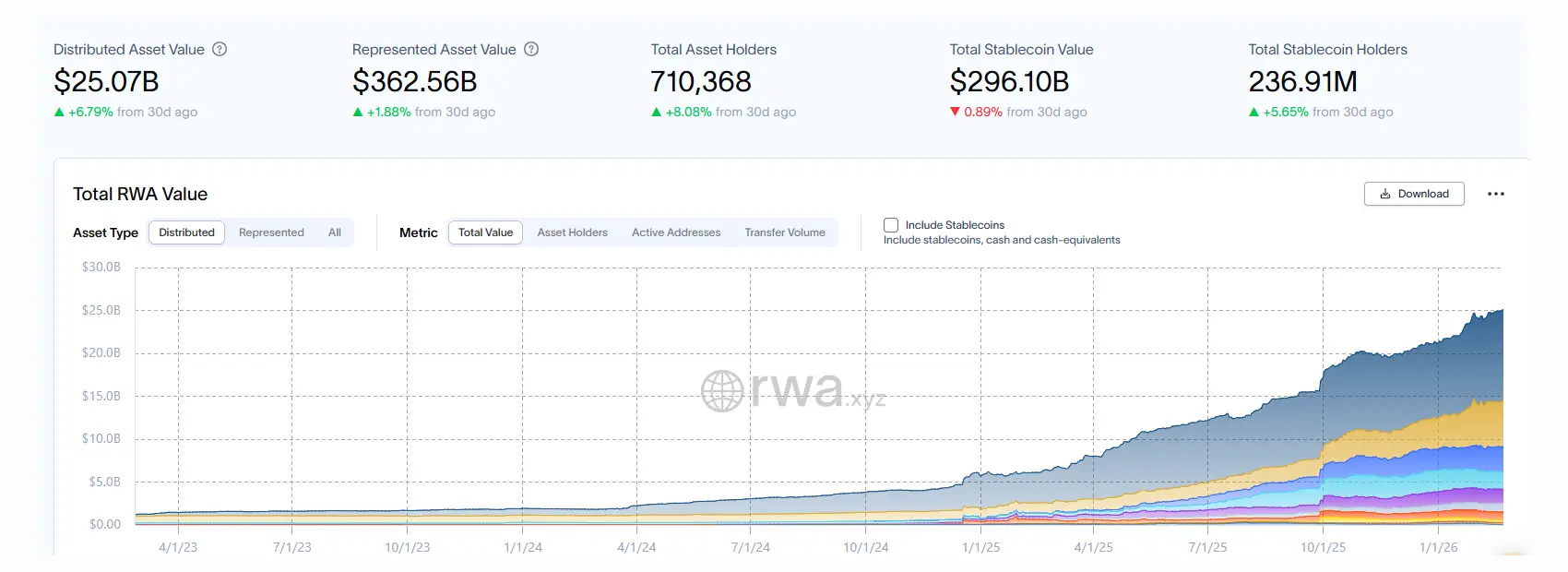
That growth tends to concentrate on yield-generating instruments like US treasuries and private credits, and recently, the rise of tokenized precious metals.
Tokenized U.S. Treasuries form the largest category, reaching ~9.6 billion USD. Growth in this segment has been even faster, around 120% YoY, supported by products such as BlackRock’s BUIDL fund, which alone accounts for about 1.7 billion USD in assets.
Other asset classes remain smaller but relevant. Tokenized money market funds, commodities, and bonds continue to expand. Gold dominates tokenized commodities, accounting for roughly 70% of the $7B tokenized commodity value.
Beyond these core categories, the market also began to diversify, with pilot activity in areas such as carbon assets and pharma R&D assets and drug cash flows.
From an infrastructure perspective, tokenization has demonstrated several capabilities. Issuance can operate within regulated frameworks. Compliance checks can be embedded into on-chain workflows. Custody and settlement can meet institutional standards.
What it has not yet demonstrated consistently is deep secondary liquidity, seamless interoperability across networks, or broad retail participation.
What Is Driving Adoption in 2026
1. Institutional demand continues to shape the market.
Most institutions approach tokenization as an extension of existing processes rather than a replacement. They tokenize assets they already understand, using structures that fit within current legal and operational frameworks. This approach lowers adoption risk and provides a clearer basis for internal approval.
This view was echoed in comments from Zeta Network Group (NASDAQ: ZNB) during its RWA tokenization evaluation. The company noted that tokenization could provide exposure to traditional asset classes through digital formats while preserving the governance and internal-control standards required of public companies. In this framing, tokenization complements traditional finance rather than replacing it.
Starting with institutional use cases also helps establish confidence before broader retail participation is considered. Distribution, governance, and reporting standards tend to mature faster in institutional settings.
2. Utility is another driver.
Tokenized assets are increasingly used beyond initial issuance. In 2025, several developments highlighted this shift. DBS integrated tokenized money market funds as collateral. Binance enabled tokenized RWAs such as USYC and cUSDO as off-exchange, yield-bearing collateral. Aave Labs introduced Horizon, allowing institutions to borrow stablecoins against tokenized assets.
These examples matter because they keep assets productive after issuance. When tokenized instruments can be used as collateral, integrated into treasury operations, or deployed across platforms, issuers are more willing to bring assets on-chain.
3. Liquidity considerations also play a role.
Assets that are already liquid or low volatility have attracted the most tokenization activity. This helps explain why U.S. Treasuries and money market funds dominate current volumes.
It also explains growing interest in tokenized securities. Exchanges and brokers such as Nasdaq, NYSE, Robinhood, Coinbase, and Kraken are exploring tokenized equities and funds. These products allow capital to remain on-chain across trading, custody, and settlement, supporting a more continuous capital lifecycle.
These drivers point to a market progressing in a measured, institution-led way. Familiar asset types, post-issuance use cases, and predictable liquidity profiles are enabling early adoption, but they also narrow where tokenization can work today. Expanding beyond these use cases will depend on resolving concrete constraints around regulation, market infrastructure, and secondary market participation.
Overcoming the Barriers to Mass Adoption
At the “Tokenization Outlook 2026: Trends, Regulations and Supercharging Adoption” panel co-hosted by the Singapore FinTech Association (SFA) Capital Markets Services Subcommittee and ASIFMA, when asked “What are the most stubborn hurdles to broader ecosystem adoption?” our General Counsel, Alice Chen, pointed to three practical constraints. First, the need to better align regulatory approaches across jurisdictions. Second, the challenge of integrating tokenization with legacy processes and infrastructure. Third, the difficulty of building sufficient participation on both the sell side and buy side to support scalable markets. (Read her panel recap).
This aligns somewhat with the remarks of MAS MD Chia Der Jiun when he outlined three conditions required for tokenized markets to scale. First, asset-backed tokens need to be standardized, and networks interoperable. Second, there needs to be a deep pool of safe and reliable settlement assets. Third, institutional-grade networks are needed.
1. Regulatory Clarity
Regulatory clarity remains the most significant barrier to RWA tokenization adoption. According to CACEIS’s survey, 58% of asset owners citing regulatory constraints as a hurdle to crypto asset investment.
While jurisdictions such as the U.S., Singapore, the UAE, and Hong Kong have made meaningful advances, regulatory approaches are still uneven. Initiatives like Singapore’s Project Guardian and BLOOM demonstrate how public-private collaboration can create controlled environments for innovation, but global consistency has yet to emerge. For institutions operating across borders, this fragmentation introduces cost and uncertainty.
2. Liquidity
Liquidity does not automatically emerge just because an asset is tokenized and brought on-chain. While billions of dollars of RWAs have been tokenized, a study on Arxiv found out that most RWA tokens exhibit low trading volumes, long holding periods and limited investor participation. As a result, tokenization has been more successful at digitizing already liquid or low-risk assets (like US treasuries and MMFs) than at unlocking liquidity for inherently illiquid ones (like real estate or fine art).
A key bottleneck lies on the buy side. Without a sufficiently broad and active investor base, secondary markets struggle to develop depth and continuity. To address this, initiatives such as Union Chain, co-founded by InvestaX, aim to connect tokenized RWAs with over 20 million users through regulated exchanges. However, building durable liquidity takes time. It requires not only distribution, but also trusted market infrastructure, aligned incentives for participants, and secondary venues that institutional investors are willing to use at scale.
3. Standardisation and interoperability
Standardisation and interoperability form a related constraint. As MAS Managing Director, Chia Der Jiun noted, asset-backed tokens issued on one network today often cannot move easily to another. This creates fragmentation and limits secondary market depth.
Regulators and policymakers have begun calling for common standards so that tokenized bonds or funds issued on one network can be recognised and transferred on another. Progress here would not only reduce operational friction but also help mitigate liquidity fragmentation across venues.
4. On- and Off-ramp Infrastructure
Finally, market infrastructure beyond the blockchain still needs work. While tokenization technology continues to mature, surrounding processes such as custody, settlement, compliance, and fiat integration require further refinement. In many cases, the challenge is less about new technology and more about connecting tokenized assets to existing financial workflows in a way that institutions can adopt at scale.
Taken together, these constraints are not unusual for a market still taking shape. The next phase of growth is likely to depend less on new token models and more on steady progress in regulation, infrastructure, and participation. Addressing these foundations now gives tokenized markets a better chance to scale in ways institutions can rely on.
Stablecoins as Settlement Infrastructure
Stablecoins, with a current market capitalization of $307 billion, are increasingly treated as settlement infrastructure rather than investment products.
Tokenized assets and stablecoins are two sides of the same coin: one represents value (asset layer) and the other moves it (payment layer). Without reliable on-chain payment rails, features such as atomic settlement and continuous markets are difficult to implement in practice.
Regulatory frameworks such as the GENIUS Act reinforce this role. Restrictions on yield-bearing stablecoins position them as settlement instruments. This shifts yield generation back to the asset layer. For investors, returns are increasingly associated with tokenized RWAs rather than the currency used to settle transactions.
As regulated stablecoin issuance expands, their integration with tokenized assets is likely to deepen. This is particularly relevant for cross-border settlement and wholesale use cases, where speed and certainty of payment matter.
Closing Thoughts: The 2026 Outlook
Entering 2026, tokenization appears less speculative and more structural.
Market volatility has encouraged a rotation toward regulated tokenization infrastructure, transparent asset structures, and familiar risk profiles. This has supported growth in tokenized private credit, government securities, and money market funds.
The next phase is about scale and integration. Tokenization has shown it can work. The question now is how consistently it can operate across jurisdictions, asset classes, and market participants.
The longer-term signal will be subtle. When tokenization no longer needs to be labelled as such, and when it becomes part of standard issuance and settlement processes, it will have reached its intended role. Until then, progress in 2026 is likely to remain measured, data-driven, and led by institutions willing to test what works.